
%20(1).jpg?width=1583&height=743&name=Carus_BLUE_1%20(1)%20(1).jpg)
Chronic gastrointestinal (GI) cases rarely follow a neat diagnostic pathway. Sometimes the next step may be clear but in reality, decisions are often shaped by a complex mix of clinical findings, patient factors, owner circumstances and the feasibility of carrying out a proposed diagnostic or treatment plan.
Faecal calprotectin is a non-invasive biomarker of intestinal inflammation that can provide objective information at points in the pathway where clinical signs alone may not give clear answers. It does not replace clinical judgement, or other diagnostic tests, but it can add useful objective data to help guide next steps and support client communication.
Faecal calprotectin and contextualised care
Faecal calprotectin is particularly relevant when considering contextualised care. While finances are often a key part, contextualised care conversations should also take into account factors such as:
- The patient’s temperament, age and comorbidities
- The owner’s ability to administer medication
- Owner willingness to follow a strict diet trial
- Whether referral is an option
- The emotional burden of decision-making
In chronic GI disease, as with other conditions, these contextual factors often influence how far and how fast the diagnostic pathway can progress.
What is faecal calprotectin?
Faecal calprotectin is a protein biomarker of gastrointestinal inflammation (Dabritz et al., 2014; Heilmann et al., 2008; Jukic et al. 2021). During gastrointestinal inflammation, the innate and adaptive immune responses are stimulated, resulting in an influx of phagocytic cells and the release of inflammatory cytokines. These chemoattract neutrophils, triggering a cascade of events leading to neutrophil disintegration (Figure 1) and the release of calprotectin into the gut lumen, where it enters the faecal stream, and can be measured in the stool (Dabritz et al., 2014; Jukic et al. 2021; Heilmann et al. 2012). Because calprotectin makes up around 60 percent of the neutrophil’s cytosol and is resistant to degradation by faecal bacteria, faecal concentrations increase in line with neutrophilic infiltration of the gastrointestinal mucosa.
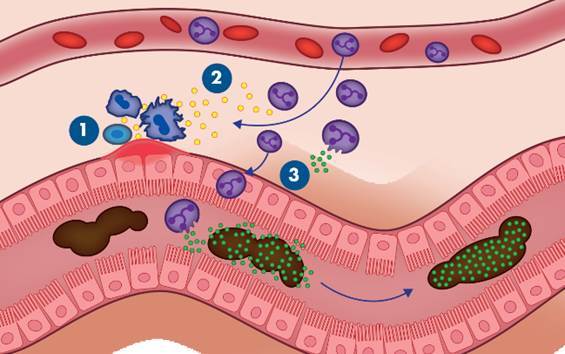
Figure 1. Mechanism of faecal calprotectin release during gastrointestinal inflammation. 1. Immune responses are stimulated. 2. Release of inflammatory cytokines. 3. Neutrophil disintegration results in calprotectin release into the gut lumen.
Faecal calprotectin testing in practice
GIQuest is a rapid point-of-care lateral flow immunoassay that uses monoclonal antibodies to detect faecal calprotectin. The test has been validated in both dogs and cats (University of Bristol, 2025).
In dogs, GIQuest has been shown to distinguish histologically confirmed inflammatory enteropathy from healthy controls, with specificity of 96 percent and sensitivity of 94 percent at a threshold of 3 mg/kg. In cats, reported specificity is 100 percent and sensitivity is 92 percent at a threshold of 2.5 mg/kg.
Clinical relevance in dogs and cats
Definitive diagnosis of chronic inflammatory enteropathy (CIE) relies on histopathology, with samples collected via endoscopic or surgical biopsy. These procedures require anaesthesia, can be costly and may not be appropriate or achievable in every case. Surgical biopsy also carries some risk, with reported complication rates following incisional full-thickness small intestinal biopsy in dogs of around 12 percent (Maggiar et al., 2023).
Faecal calprotectin can help fill the gap between clinical suspicion and more invasive diagnostics. It does not identify the underlying cause of inflammation, or replace histopathology where this is required, but it can provide objective evidence that intestinal inflammation is present.
Faecal calprotectin testing may be useful to:
- Support decision-making when invasive diagnostics are declined or delayed
- Help identify cases that may benefit from a diet trial
- Monitor response to diet or treatment trials
- Support owner understanding and compliance with management plans
- Monitor GI health in patients receiving long-term oral NSAIDs
Prioritising the next step when clinical signs are non-specific
Many chronic GI cases begin with mild or intermittent signs such as occasional vomiting, soft faeces, borborygmi, variable appetite or subtle weight change. The patient may appear well in the consult room and owners may attribute signs to stress, scavenging, eating too quickly or a ‘sensitive stomach’.
In these cases, it can be difficult to know whether monitoring is appropriate, whether a structured diet or treatment trial is justified, or whether further investigation should be discussed.
In human medicine, faecal calprotectin is used to evaluate treatment response, anticipate relapse and reduce reliance on repeated endoscopic reassessment (Lee & Park, 2022; Diederen et al., 2017). In veterinary patients, faecal calprotectin can help prioritise the next step and support case management by:
- highlighting cases where intestinal inflammation is present, even when signs are vague or intermittent
- supporting escalation where levels are clearly elevated, particularly if referral, imaging, endoscopic or surgical biopsy is being considered but the owner is unsure
- ruling out active GI inflammation where results are normal, allowing the clinician to reconsider the differential diagnosis or change the diagnostic pathway
- reducing the urgency for invasive diagnostics where results are normal or borderline and the patient is otherwise stable, particularly where there are financial or practical constraints
- showing whether inflammation is reducing on repeat testing, helping assess treatment response and supporting owner compliance
- helping differentiate likely inflammatory flares from episodes where stress or behaviour may be contributing to signs
- making client communication more objective, especially when owners do not yet see the need for further investigation
Diet trials
Food responsive enteropathy (FRE) is one of the most common forms of CIE, with more than half of dogs with chronic enteropathy falling into this category (Jergens & Heilmann, 2022). While response rates to dietary trials can be as high as 88% (Jugan, 2020), a successful diet trial is not always straightforward.
The latest ACVIM-endorsed CIE consensus statement recommends that clinically stable dogs with suspected CIE undergo dietary treatment trials before invasive diagnostic testing (Heilmann et al., 2026). Each trial should involve exclusive feeding of a therapeutic diet for at least two weeks, with the choice guided by the dog’s dietary history, clinical signs and diagnostic findings.
- A good response is often seen within two to four weeks, although this varies between individuals and some authors recommend persevering for up to 12 weeks (Heilmann et al., 2026; Jergens & Heilmann, 2022; Walker & McMahon, 2019).
- At least three trials using different therapeutic diets should be considered where possible, as some dogs may not respond until the second or third option is tried. (Prantil, 2023; Heilmann et al., 2026).
- Once a diet induces clinical remission, it should generally be continued for at least 12 weeks before attempting to transition away from it.
Throughout this process, strict compliance is essential but this can be difficult for many owners, especially if improvement is slow or partial.
Faecal calprotectin in diet trials
Faecal calprotectin can help make the diet trial more measurable and support owner compliance by:
- providing a baseline marker of intestinal inflammation before the trial starts
- showing whether inflammation is reducing, potentially before clinical signs have fully improved
- helping explain why further dietary refinement may be justified if levels fall but do not normalise
- supporting longer-term monitoring after a successful trial, as rising concentrations may indicate relapse before overt clinical signs return
Oral NSAID monitoring
Non-steroidal anti-inflammatories (NSAIDs) are central to perioperative analgesia and chronic pain control, including for osteoarthritis management. Most dogs tolerate NSAIDs well, but cyclooxygenase (COX) inhibition can reduce prostaglandin synthesis and compromise important physiological functions, particularly those mediated by COX-1. The GI tract is the most frequent site of NSAID-associated adverse effects (Hunt et al., 2015).
The challenge is that much of this pathology develops without clinical signs. In a study of dogs receiving NSAIDs for a median of six months, more than 80% had mucosal erosions on video capsule endoscopy (VCE) (Mabry & Tolbert, 2021).
Faecal calprotectin and NSAID monitoring
In a University of Bristol study of 20 dogs receiving oral NSAIDs, faecal calprotectin was measured pre-treatment and 14 days after starting treatment, using the GIQuest point-of-care test. After 14 days of NSAIDs, 25% of dogs exceeded the faecal calprotectin inflammatory threshold despite no reported clinical signs (Williams et al., VOACON 2026).
Faecal calprotectin can support NSAID monitoring by:
- reassuring owners that GI health is being monitored proactively and non-invasively during NSAID therapy
- helping detect subclinical GI inflammation before clinical signs develop
- supporting reassessment of the NSAID plan where results suggest inflammation, helping guide conversations around dose, duration, gastroprotective treatment, alternative and multi-modal analgesia or closer follow-up
- giving owners a clearer reason to report subtle changes such as reduced appetite, soft faeces or behavioural signs of discomfort
- improving owner confidence and treatment compliance when results do not indicate intestinal inflammation
Making the next step clearer
In practice, the value of faecal calprotectin lies not in making a diagnosis on its own, but in helping answer a more immediate clinical question: is clinically relevant intestinal inflammation likely to be present, and how does that change what I do next?
This can be particularly useful in first-opinion practice, where decisions are often shaped by clinical uncertainty, owner concerns, patient factors and the practicalities of carrying out a diagnostic or treatment plan. A raised result may support further investigation, referral, biopsy or a structured diet or treatment trial. Normal or borderline results in a clinically stable patient may support monitoring alone or continuation of a treatment plan.
Used appropriately, faecal calprotectin can help make chronic GI care more structured, more measurable and easier to discuss with owners.