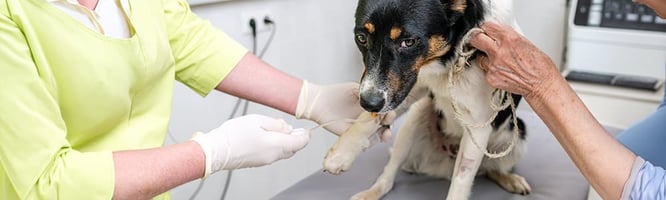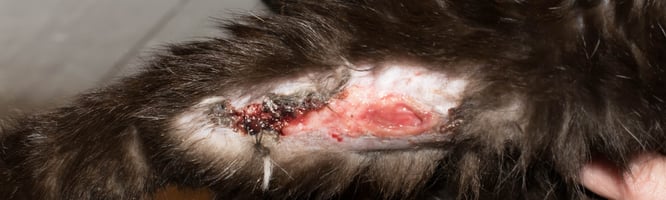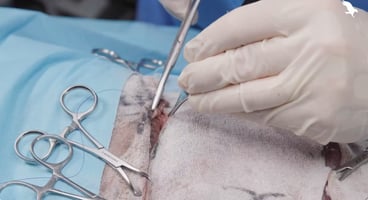

Gastrotomy is a common surgical procedure in small animal practice, often utilised for foreign body removal or, less commonly, to enable gastric biopsy. In this video, created by Jon Hall MRCVS, RCVS Specialist in Small Animal Surgery, you can see a detailed explanation of gastrotomy.
Step by step gastrotomy
Step 1: Patient prep and positioning
Patients undergoing gastrotomy should be anaesthetised, and placed in dorsal recumbency. A large area should be clipped and prepared - usually from a couple of inches cranial to the xiphoid all the way to the pubis and the full width of the abdomen. Pain relief will be needed, but NSAIDs may be contraindicated depending on the condition. Intravenous prophylactic antibiotics are often appropriate, as any surgery involving the GI tract without concurrent peritonitis should be considered clean-contaminated.
Step 2: Surgical approach
A midline incision is made from the xiphoid to the umbilicus. Balfour retractors can then be used to expose the cavity. Before any surgery takes place, it is standard practice to undertake an examination of the abdominal contents, checking for viability and abnormalities.
Step 3: Incision and Closure
- Place two stay sutures in the fundus using 3/0 or 4/0 monofilament suture - this allows you to manipulate the stomach atraumatically. Ideally, aim for an avascular area midway between the greater and lesser curvatures of the stomach, but this should be based on your assessment of normal viable stomach areas.
- Pack moistened laparotomy swabs around the stomach - this helps keep the stomach exteriorised and serves to catch any leakage of contents.
- Incise between the stay sutures with a stab incision, then extend this using Metzenbaum scissors. The ideal length of the incision will depend on the reasons for surgery.
- Once the biopsies have been taken or the foreign bodies have been removed (whilst avoiding contamination of the abdomen), the incision can be closed in a two-layer closure using 3/0 or 4/0 monofilament absorbable suture such as PDS in a simple continuous pattern.
- The video below shows gastrotomy incision and closure in detail:
Step 4:
Flush the abdomen with sterile saline (if spillage occurred, 1L per 10kg bodyweight recommended) and count out all laparotomy swabs. Close the celiotomy incision as normal. Don't forget pain relief - a splash block of local anaesthetic before skin closure can be a useful adjunct. Recover the patient as normal.
_BL_CourseThumb.jpg?width=500&height=300&name=IVE_GPCert(STS)_BL_CourseThumb.jpg)

Small Animal Soft Tissue Surgery
ISVPS General Practitioner Certificate (GPCert)
Postgraduate Certificate (PgC)
 Apr 2026
 Online/Swindon
Author