
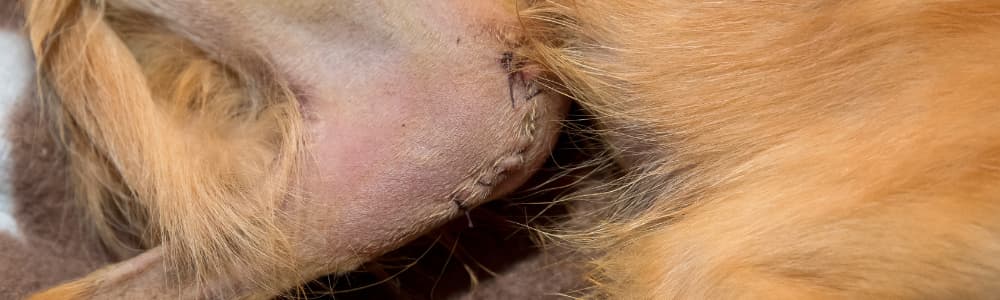
A small prospective, randomised controlled study published in the American Journal of Veterinary Research found that kinesiology tape applied in a double-lymphatic pattern reduced soft tissue swelling around the stifle during the first 24 hours after tibial plateau-levelling osteotomy (TPLO). The authors describe the approach as simple, low-cost and non-invasive, with no adverse effects reported in the taped dogs.
For vets and RVNs, the paper is not evidence that taping improves long-term recovery after cruciate surgery. However, it does suggest that kinesiology taping may have a role as an adjunct to postoperative care, particularly for teams with an interest in rehabilitation, swelling control and patient comfort.
Why this matters in practice
Postoperative swelling is common after orthopaedic surgery, and managing it is part of good patient care. In first-opinion and referral practice, nurses are often closely involved in postoperative checks, limb assessment, comfort monitoring, cold therapy, discharge advice and rehabilitation planning.
Kinesiology tape is already used in some veterinary rehabilitation settings, but published canine evidence has been limited. The authors note that previous studies in dogs have found minimal effects on gait or mobility in healthy animals, while evidence in people and horses after stifle or knee procedures has been more encouraging.
This study therefore adds a small but relevant piece of canine-specific evidence: in dogs undergoing TPLO, taping may reduce early postoperative swelling at some measured points around the surgical stifle.
What did the study do?
The study recruited canine stifles undergoing TPLO between October 2023 and June 2025. Stifles undergoing a first cranial cruciate ligament repair were included, while dogs that were not amenable to handling or were discharged to owner care overnight were excluded.
Thirty-one stifles were randomised into two groups. Sixteen had kinesiology tape applied to the surgical stifle immediately postoperatively in a double-lymphatic pattern, while 15 had no tape applied. The tape remained in place for 24 hours.
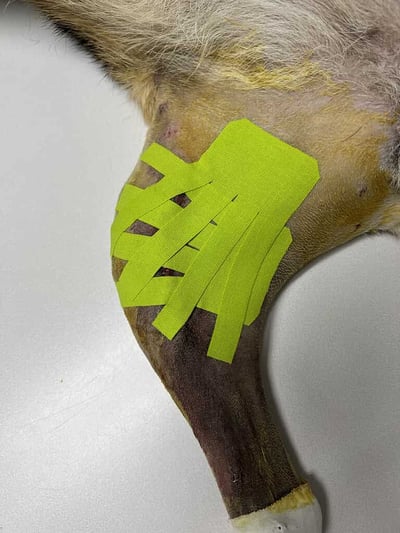
The double lymphatic pattern used in the study. Image citation: American Journal of Veterinary Research 87, 5; 10.2460/ajvr.25.11.0398
The researchers measured limb girth using a pressure-sensitive measuring tape at three sites: the lateral fabella of the femur, the joint line and the tibial tuberosity. Measurements were taken immediately before surgical preparation, immediately postoperatively, three hours postoperatively, 18 hours postoperatively and 24 hours postoperatively.
What did they find?
Dogs in the taped group had significantly less swelling than controls at the lateral fabella of the femur at 18 and 24 hours after surgery. They also had significantly less swelling at the tibial tuberosity at three, 18 and 24 hours after surgery.
The study did not report adverse effects from the kinesiology tape, and the application was described as well tolerated.
The authors concluded that kinesiology tape applied in a double-lymphatic pattern immediately after TPLO reduced soft tissue swelling during the early inflammatory period.
What could this mean for vets and RVNs?
For practice teams, the most useful message is that taping may be worth considering as a postoperative adjunct in appropriate TPLO cases, particularly where staff are trained in correct application and monitoring.
For RVNs, this paper may be especially relevant because postoperative limb checks are often nurse-led. Tape position, skin comfort, swelling, bruising, patient interference, bandage or dressing conflicts, and owner instructions all need practical oversight.
For vets, the findings may support conversations about multimodal postoperative care. Kinesiology taping should not replace analgesia, appropriate surgical technique, controlled exercise, physiotherapy planning or other swelling-management strategies. But in selected cases, it may be another tool to consider.
The “selected cases” point matters. The direction and pattern of tape application are part of the proposed mechanism, and the authors discuss that incorrect application could potentially affect fluid movement in the wrong direction. This is not something to apply casually without training.
What are the limitations?
The study was small, with only 31 stifles included. That makes it useful as early evidence, but not enough to define broad postoperative protocols.
The follow-up period was also very short. The study looked at swelling over the first 24 hours after TPLO, so it does not tell us whether taping improves pain scores, weight bearing, range of motion, complication rates, time to functional recovery or long-term outcome.
The control group had no tape rather than sham taping, so the study specifically compares this taping technique with no taping. It does not fully separate the effect of the tape pattern from other possible handling or application-related factors.
The findings also apply to dogs undergoing TPLO in the context of this study design. They should not automatically be extrapolated to other orthopaedic procedures, non-surgical stifle injuries, chronic swelling, or home application by owners.
The bottom line for practice teams
This AJVR study suggests that kinesiology taping in a double-lymphatic pattern may reduce early postoperative stifle swelling after canine TPLO.
For vets and RVNs, the practical takeaway is cautious but useful: taping could be a simple adjunct for swelling control when applied correctly and monitored appropriately. It should be seen as part of a wider postoperative plan, not as a substitute for analgesia, surgical follow-up or rehabilitation.
The paper is also a reminder that small, practical interventions can still be worth studying. For teams already using kinesiology tape, it provides some supportive canine evidence. For teams not using it, the study may justify further discussion or training rather than immediate routine adoption.
Source: Ludwig B, Ihrke A, Holich K, Neforos K, Heidel RE. Kinesiology taping with a double-lymphatic pattern reduces canine stifle joint swelling 24 hours after tibial plateau-leveling osteotomy. American Journal of Veterinary Research, 87(5), 2026. doi: 10.2460/ajvr.25.11.0398.
Author