
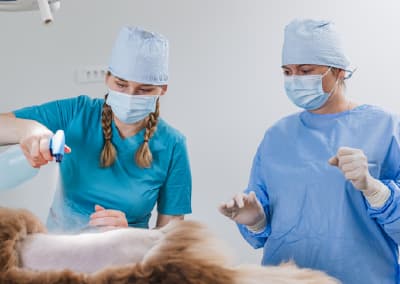
Practical CPD courses are vital for veterinary professionals to refine hands-on skills, build confidence, and stay updated on advanced techniques. While our practical veterinary CPD courses offer unparalleled learning opportunities, they can be intense, so a bit of careful planning and preparation can make sure you make the most of the opportunity. Here are 5 tips to ensure you leave your next practical CPD session with skills you can immediately apply in practice.
1. Prepare thoroughly before your practical CPD course
Before your CPD course starts, make sure you prepare...
Print notes or slides in advance
We share digital copies of our course notes ahead of time. Print these resources (adding more space for hand-written notes if needed) and annotate them during the course to capture insights without scrambling to write everything down. Highlight key sections (e.g., surgical steps, drug protocols) to focus on during hands-on practice.
Research the topic and speakers
Familiarise yourself with the course content and speaker expertise. This primes your brain to absorb complex information and helps you ask targeted questions during sessions.
Pack smart
As well as your course notes, you might want to bring a notebook, pens (several!), and a phone for recording videos. Depending on your course, you may also want to bring a tablet/laptop, and the necessary chargers to get you through the session(s).
2. Optimise note-taking during and after your practical CPD course
Because practical CPD is... well... practical, note-taking can get forgotten. Try to find ways that work for you and the type of course you're taking so you can take your new skills and knowledge back to practice.
Use shorthand and symbols
Replace full sentences with abbreviations. Only write down key points to help engage your brain – if you write down everything, you’ll struggle to pull out the important bits later
Divide your notes
Create dedicated sections for:
- Techniques: Step-by-step procedures.
- Tips & Tricks: Instructors’ insights (e.g. “Use mosquito forceps to reduce tissue trauma”).
- Questions: Items to revisit post-course
Leverage digital tools
Use apps like OneNote or Evernote to organise notes, photos, videos and audio clips. Tag entries by topic for easy searching later. Note – this is usually best done after the course, as it will help embed your learning.
3. Record key demonstrations (with permission)
Video critical techniques
Ask the tutor’s if you can film complex procedures. A short clip of a suture pattern or instrument grip can be invaluable when replicating it in practice.
Capture audio explanations
Use your phone’s voice memo feature to record a tutor’s rationale for specific methods or as a quick way of making notes. Pair these with your written notes for context.
Edit and annotate later
After the course, trim recordings to highlight key moments and add text annotations (e.g., “Note: Apply tension here”). Store files in a dedicated folder for quick access.
4. Build a post-course support network
Exchange numbers with participants during breaks and start a group chat on WhatsApp. Use it to:
- Share photos of notes or diagrams.
- Discuss challenges when applying skills once you're back in practice
- Ask for help!
- Share case studies or outcomes post-course.
Don't forget to follow up!
You could make an effort to message the group 1-2 weeks after the practical CPD course is over. Compare experiences implementing techniques and troubleshoot issues together.
Connect with instructors
Follow speakers on professional networks like LinkedIn and keep the relationship active for future advice and support.
5. Cement learning with a recap
That old saying "watch one, do one, teach one" is true. You'll remember everything from your CPD course better if you recap it again later.
Teach others in your practice
Present a summary to colleagues during a team meeting or practical demo. Explaining concepts reinforces your knowledge and benefits your clinic.
Set SMART goals
Based on your practical CPD course, define objectives like:
- Perform 5 dental radiographs independently by a specific date.
- Audit post-op pain scores using the new protocol within 3 months.
Make sure the goals are time-bound and achievable to make follow up as easy as possible.
Reflect on your practical CPD course
Don’t forget, you need to log your CPD on the 1CPD app/platform and reflect on it for it to count towards your CPD hours. It might also help to upload your notes and CPD certificate as evidence of your practical training. (If you’re struggling with reflection, our article on reflecting on your veterinary CPD has helpful hints and prompts to help you!)
Final thoughts
Practical CPD courses are an investment in your professional growth. By preparing in advance , recording key insights as you go using videos and notes, and fostering peer networks, you can turn hands-on training into lasting clinical impact.
Ready to put theory into practice? Explore our practical veterinary CPD (or our practical CPD for veterinary nurses), designed to maximise hands-on learning with expert guidance in our state-of-the-art facilities.




.jpg?height=200&name=IVE_UK_BlogImage_Not%20all%20CPD%20is%20the%20same-%20how%20to%20choose%20a%20format%20that%20works%20for%20you_Jan2025%20(1).jpg)