It’s hard to believe it’s already been six months since I started Improve Veterinary Education’s Diagnostic Imaging Postgraduate Certificate Programme - what a journey it’s been so far! Now that I’m seven modules down, I wanted to share some of my biggest takeaways (plus a few tips and tricks that have really helped along the way).
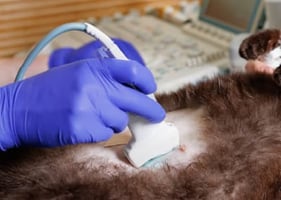
Over the past few months, I’ve completed two hands-on practical modules alongside the online learning component of the programme. For me, that combination has been one of the standout features. The theory provides the essential foundation, but applying it in a practical setting is where everything really clicks into place. Gaining real experience in ultrasonography helped cement the knowledge in a way that purely theoretical learning just can’t replicate.
Developing a Systematic Approach to Abdominal Ultrasound
One of the biggest breakthroughs for me has been adopting a systematic approach to abdominal ultrasound scanning. Before starting the course, I didn’t always follow a consistent structure. Now, I approach every scan the same way - working through each organ in turn, which has improved both my efficiency and my confidence. I’m much less likely to miss subtle changes, and I finish scans feeling reassured that I’ve performed a thorough examination.
A major part of this progress has been strengthening my understanding of normal anatomy. The more comfortable you are recognising what ‘normal’ looks like, the easier it becomes to spot what isn’t. Through repetition, case-based discussions, and guided feedback, I’ve become much more confident identifying common pathological changes and interpreting them within the wider clinical picture.
Refining Technique and Image Quality
Another area where I’ve seen real improvement is probe handling and image optimisation. It’s amazing how small adjustments in probe angle, pressure, or positioning can dramatically change image quality. Learning to consistently acquire diagnostic-quality images has been genuinely transformative.
Understanding depth, gain, and focal zones in a more meaningful way has also made scanning far less frustrating. Instead of simply hoping for a better image, I now know how to actively improve one.
Taking the First Steps in Echocardiography
The programme also introduced me to basic echocardiography – an area that initially felt quite daunting.
However, breaking echocardiography down into standardised views and structured, repeatable techniques made it much more approachable. Learning how to obtain standard views and understand fundamental cardiac measurements has opened up an entirely new dimension of imaging for me.
Having a clear framework to follow has been instrumental in building confidence, and what once felt intimidating now feels achievable with practice and consistency.
Bringing New Skills into Practice
Since completing these modules, I’ve been actively using my new skills in practice. I’m now offering abdominal ultrasound and basic echocardiography in-house, which has significantly enhanced the level of service we can provide to our patients.
Increasing my imaging caseload has been essential. The more cases I see, the more everything consolidates - technique, interpretation, and clinical reasoning all strengthen with repetition. Each case genuinely builds on the last.
Perhaps most importantly, my mindset has shifted. Rather than viewing ultrasound as an optional “add-on,” it has become a central, reliable diagnostic tool in my day-to-day clinical decision-making.
Tips and Tricks I’ve Found Helpful
If you’re considering further training in diagnostic imaging - or are already on a similar journey - here are a few things that have helped me:
- Be systematic every time. Even when you’re busy, stick to your structured approach.
- Master normal first. Confidence in recognising normal anatomy is the foundation for spotting pathology.
- Optimise before you interpret. Always adjust your settings to get the best possible image before drawing conclusions.
- Scan as often as you can. Confidence comes with repetition.
- Reflect on your cases. Reviewing images afterwards, especially challenging ones, accelerates learning.
Six months in, I can genuinely say this journey has transformed how I approach diagnostic imaging. There’s still so much to learn - but that’s part of the excitement. With every module and every case, I can feel myself becoming a more confident clinician.
I’m really looking forward to seeing what the next six months bring!
_BL_CourseThumb.jpg?width=500&height=300&name=IVE_GPCert(DI)_BL_CourseThumb.jpg)

Diagnostic Imaging
ISVPS General Practitioner Certificate (GPCert)
Postgraduate Certificate (PgC)
 September 2026
 Swindon
Author