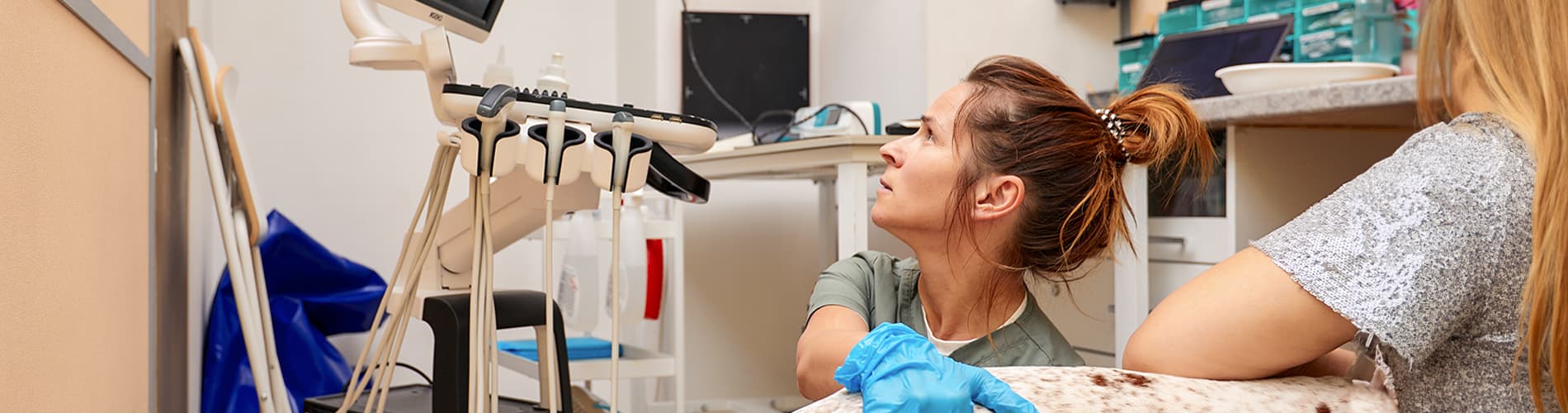
Develop your knowledge and practical skills in a range of imaging modalities
This Diagnostic Imaging Nurse Certificate (NCert) programme is for RVNs working in or wishing to advance their skills in this area. The ability to produce high-quality images in a safe environment is essential in accelerating the diagnostic process.
This programme will provide you with the confidence and skills to work with the different imaging modalities and techniques, enabling you to obtain information that can contribute to a wider diagnostic picture. It also offers a practical element with radiographic positioning and Point of Care Ultrasound (POCUS).
What you'll learn:
-
The fundamental principles of radiology, ultrasonography, CT, and MRI and their applications.
-
How to produce high-quality images, manage a safe working environment as well as indications for fluoroscopy, a variety of contrast studies, interventional radiology and POCUS.
-
An understanding of normal anatomy and physiology, and how these impact on the pathogenesis and treatment of medical conditions will be expected.
Why choose this programme?
-
The blended delivery of this programme allows the essential theory of this subject to be presented online in an interactive and engaging way whilst the practical teaching provides skills that can be applied directly in practice.
-
The eight-module programme comprises four face-to-face modules (modules 1, 2, 5, and 6) which will include practical elements where appropriate, and four online learning modules.
-
This comprehensive training, coupled with practical experiences, empowers you to approach challenges in practice with assurance and competence.
Diagnostic Imaging Nurse Certificate (NCert): Why this programme is for you!
Hear what our delegates have to say
Don’t just take our word for it - our delegate feedback speaks for itself.
Garrick Ponte
BVSc GPCert(SAM) MRCVS
The teaching at Improve is excellent and I have been able to take what I have learnt back to use in practice. It’s not just the lectures themselves but the practical work we did straight afterwards which drives home everything, which is why Impro … Read more
Colin Dickson
BVMS CertAVP MRCVS
Having previously completed a postgraduate surgery certificate with another provider, I was confident in my knowledge and understanding of the theory but felt underprepared from a practical perspective. I was initially hesitant to register for another … Read more
Key features of this programme
Four two-day modules
Gain a recognised qualification
Access to learning resources
A dedicated Programme Coordinator who will support you every step of the way
A discussion forum for conversation, debate and sharing cases with your peers
Four two-day modules
Gain a recognised qualification
Access to learning resources
A dedicated Programme Coordinator who will support you every step of the way
A discussion forum for conversation, debate and sharing cases with your peers
Programme details
Module Summary
01 - Radiography principles, technique and Interpretation
Key learning objectives
• Compare traditional, computed and digital radiography, including image acquisition, viewing and storage.
• Assess radiographic image quality and methods to improve it, including grids, image interpretation and PACS.
• Set up the radiography room and patient safely, using appropriate positioning aids and physical or chemical restraint, including for exotic patients.
• Apply legal and radiation-safety requirements, including IRR, ALARA, PPE, dosimeters and additional precautions during pregnancy.
02 - Radiography of the head, teeth, neck, thorax, abdomen, vertebral column and limbs: radiographic positioning
Key learning objectives
• Use radiographic nomenclature and positioning terminology and obtain diagnostic projections of the head, teeth, neck, thorax, abdomen, vertebral column and limbs.
• Select appropriate thoracic and abdominal views and position, restrain, collimate and centre patients accurately, including inflated thoracic views.
• Obtain forelimb, pelvic and hindlimb views, including TPLO and BVA hip and elbow scoring views.
• Recognise normal dental anatomy and breed variation and assess dental radiographs systematically.
03 - Contrast techniques in radiography
Key learning objectives
• Explain the applications, benefits and principles of radiographic contrast studies, including positive and negative media, ionic and non-ionic contrast and double-contrast techniques.
• Explain horizontal-beam use and safety precautions.
• Select and describe appropriate techniques for static barium swallow, gastrogram, barium enema, urogram, double-contrast cystography, myelography and arthrogram, including equipment, patient preparation, contraindications, risks and complications.
• Assess patient suitability for contrast administration and recognise and manage complications, including anaphylaxis.
04 - Ultrasonographic principles, technique and interpretation
Key learning objectives
- Explain the principles and application of ultrasound.
- Classify the different types of probes and explain their use.
- Discuss Doppler ultrasonography and explain its use.
- Outline the maintenance required for the ultrasound machine and care for the probes.
- Perform set up of the machine and record ultrasound images and videos.
- Define ultrasonographic terms to allow correct description. Explain ultrasound machine settings and controls and be able to optimise image quality.
- Discuss various protocols that allow a systematic and complete assessment of the abdomen and its contents.
- Recognise commonly seen artefacts and demonstrate strategies to avoid artefacts and/or distinguish diagnostically useful artefacts.
05 - Point Of care ultrasound (POCUS)
Key learning objectives
- Demonstrate set up of the machine and patient preparation.
- Describe and understand the applications of POCUS: abdominal and thoracic trauma and lung ultrasound
- Recognise the normal appearance of the abdomen and thorax when using POCUS.
- Interpret ultrasonographic changes of the abdomen and thorax when using POCUS.
- Classify the different types of sampling techniques including ultrasound guided fine needle aspirate and tru-cut biopsy. Discuss how to maximise cell preservation in both obtaining and storing the samples.
- Describe equipment necessary to perform different tissue sampling techniques.
- Outline the correct procedure for liver biopsies including patient preparation, sedation, pre-procedure blood test(s) and post procedure care.
- Practical scanning.
06 - Magnetic resonance imaging (MRI)
Key learning objectives
- Describe MRI principles.
- Demonstrate good patient positioning.
- Outline the requirements to safely anaesthetise patients for MRI.
- Discuss why ECG monitoring is not typically utilised in an MRI setting and outline alternatives to monitor cardiac function.
- Explain why traditional warming methods cannot be used in an MRI setting and give alternatives.
- Explain image acquisition and formation.
- Describe MRI sequences and understand their use and application for image interpretation.
- Recognise commonly seen artefacts and how to avoid them.
- Summarise the importance of MRI safety.
07 - Interventional radiography
Key learning objectives
- Discuss the principles of fluoroscopy and how they differ from traditional radiography.
- Explain equipment set up, controls and image acquisition.
- Review image or video acquisition, image rotation for interpretation.
- Explain how to prepare the room, patient and the material necessary to perform fluoroscopy techniques.
- Outline the use of a pressure injector.
- Discuss dynamic barium swallow studies, including indications for such a study, doses used and procedure.
- Discuss a dynamic airway exam with the use of fluoroscopy, including indications for such a study and procedure.
- Summarise the requirements for radiation protection.
- Discuss ways to minimise radiation when using fluoroscopy.
08 - Computed tomography (CT)
Key learning objectives
Qualifications
Nurse/Veterinary Paraprofessional Certificate (NCert/VPPCert)

This course is accredited by ISVPS and allows you to achieve a Nurse/Veterinary Paraprofessional Certificate
To attain the ISVPS NCert qualification, you must be able to prove your eligibility by either uploading your veterinary nursing qualification certificate or RCVS/VCI number to Improve Veterinary Education once you have booked onto your programme of study.
You can attend the modules if you are a student, or not in practice and enrolled with the RCVS; however, you will not be able to attain the ISVPS NCert qualification.
To attain the VPPCert, candidates must pass the eligibility criteria as set by ISVPS. Please contact us for further information.

Pricing
£3,499.00
£3,799.00Payment & VAT Information
1. Many of our courses come with deferred payment and instalment options. Click “Book Now” to see what’s available for this course.
2. All prices will be displayed exclusive of local sales tax.
3. For corporate-paid registrations, the associated corporate discount will apply to the regular course price and cannot be combined with Early Price or other promotions.
Payment Terms & Conditions
Registration Information
100% Satisfaction
We're completely confident in the quality of our training and CPD. So much so that if you're not 100% satisfied with your certificate course, we'll give you a 100% refund. Just get in touch with us within 30 days of your start date and we'll sort the rest. T's and C's apply.
Find out more
FAQs
Veterinary Nurse Certificates
What’s not included in the programme fee? Do I need to budget for any other costs?
What does the programme fee for the vet nurse certificate include?
How long does it take to study a veterinary nurse certificate programme?
How will studying a veterinary nurse certificate programme benefit me and my practice?
What are the assessments for the NCert/VPPCert?
Does the Nurse Certificate/Veterinary Paraprofessional Certificate award postnominals?
What is a Veterinary Paraprofessional Certificate (VPPCert)?
What is a Nurse Certificate (NCert)?
How long do I have to complete a veterinary nurse certificate?
Who is eligible for the veterinary nurse certificate programmes?
What qualifications are needed for the nurse certificate programme if coming from other countries?
Practical Sessions
Where are practical CPD courses or face-to-face modules held?
What will the timings be for face-to-face certificate modules and practical CPD sessions? How will my day be structured?
Where do the cadavers come from for the practical CPD and surgical modules/courses?
What should I wear to a practical CPD course/module?
I will be travelling from overseas, do I need a Visa?
Will the dogs used for practical CPD courses be sedated?
Will the dogs used for scanning have any abnormalities?
Are the dogs used for ultrasound CPD clipped?
Are cats used for any of the ultrasound courses?
Payments & Finance
What payment methods do you accept?
Do you offer any flexible payment plans?
What payment methods can I use for setting up a direct debit?
Do you issue separate invoices for each instalment?
Why was my Direct Debit payment not charged on the day that is established in my payment plan?
Why couldn’t I make payment during check-out?
Where can I find the bank details for the bank/wire transfer?
What happens if my circumstances change and I need to cancel my order?
When is payment for my veterinary CPD course due?
How much do the veterinary CPD courses and certificate programmes cost?
My CPD course includes assessments with ISVPS, how do I make payment for these?
Can I pay by Direct Debit?
Our Clinical Excellence Centre
Discover the new Improve Veterinary Education Clinical Excellence Centre featuring two surgical wet-lab training theatres and a radiology suite.
Find out more