
In veterinary practice and clinical animal behaviour work, clear advice does not always translate into action at home. It is rarely because an owner has not listened. More often, there is a gap between what has been advised and what is manageable in that household at that point in time. Reviews of behaviour change interventions support that point, while also highlighting that animal outcomes often depend on changing human behaviour, and that the literature remains limited by inconsistency in how such interventions are designed, described and evaluated(Glanville et al., 2020). This article outlines how behaviour change science can help veterinary teams and clinical animal behaviourists identify barriers to owner follow-through, shape workable recommendations, and review progress in consultations.
Why do we need to consider behaviour change science?
Most cases rely on repeated human action for successful treatment. A veterinary treatment plan may depend on medication being given consistently, exercise being restricted after surgery, or home care becoming part of the daily routine. A behaviour plan may require changes to greetings, lead handling, visitor management, enrichment, or the set-up of the home. In each case, the outcome depends partly on what happens between appointments.
Although easy to acknowledge, this can be underestimated in practice. Consultations rightly focus on assessment, treatment options, risk, and next steps. Much less attention is often given to whether the plan can be carried out once the client gets home. This is particularly relevant in behaviour work, where a plan may be technically sound yet still fail because it is too complex, too demanding, hard to sustain, or poorly matched to the home environment.
Behaviour change science is useful here because it shifts the focus away from why an owner is not following advice to a more practical one: what is making the plan difficult to carry out?
Using COM-B in practice
A useful framework here is The Capability, Opportunity, Motivation, Behaviour (COM-B) model, developed by Michie and colleagues (2011), which proposes that behaviour depends on capability, opportunity and motivation. Its value in practice is that it offers a structured way to think about why sensible plans may break down. Failure is often framed as poor adherence when the barrier may instead lie in practical skill, household constraints, competing demands, or emotional strain.
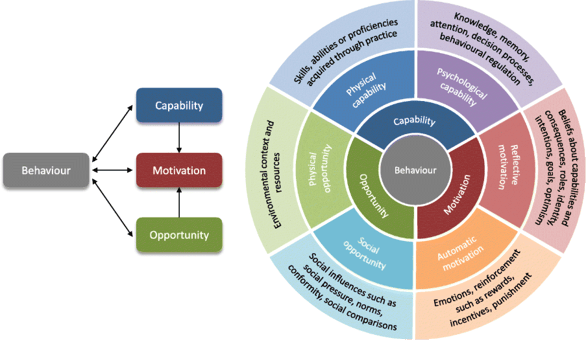 Figure: The COM-B Model (McDonagh et al., 2018).
Capability
Capability encompasses more than understanding the advice given. An owner may grasp the recommended approach yet still struggle with the skill involved. Giving eye drops to a worried dog, fitting a harness correctly, using food appropriately around high arousal, or carrying out a training exercise with good timing can be harder than they sound. Written instructions may help, though they are rarely enough on their own.
Opportunity
Opportunity is just as important. A plan that appears straightforward in the consulting room may be much harder in a busy family home, a multi-person household, or where time, money, mobility, work patterns or caring responsibilities are already stretched. Restricting a lively adolescent dog after orthopaedic treatment is one example. So is trying to manage greetings and visitors where different family members respond in different ways. In feline cases, the practical difficulty may lie in separating feeding areas, increasing litter tray provision, or making environmental adjustments in limited space.
Motivation
Motivation is multifaceted and needs to be understood broadly. While willingness plays a role, it also includes habits, confidence, emotional load, attitudes and beliefs about the animal, previous experiences, and the competing demands of ordinary life. Owners may feel guilty about changing routines, such as a favoured walk, uneasy about using management, such as muzzling and the training involved, worried about causing distress, or embarrassed to admit that a plan is not working. The emotional climate of the consultation can influence what happens next. Clients may already feel judged, exhausted, concerned about safety, or at odds with one another about how the animal should be handled, all of which affect follow-through.
This structure also aligns with the wider behaviour change literature, which argues that interventions often fail when the target human behaviour is not clearly defined, or when insufficient attention is paid to the context in which that behaviour occurs (Glanville et al., 2020; Michie et al., 2011).
This helps explain why repeating advice often fails to solve the problem and may, in some cases, add to it. A client who already feels stretched is unlikely to carry out a complex plan more effectively because they have been given even more information. What helps more is identifying the main barrier, simplifying the task, and agreeing on a starting point that is feasible.
What veterinary communication research suggests
Communication research within veterinary medicine supports this, although the evidence needs careful reading. In an exploratory Swedish study focused on canine dental home care, Brunius Enlund et al. (2021) found that consultations were often dominated by advice-giving, with limited use of client-centred communication techniques associated with motivational interviewing. This highlights a potential mismatch between what veterinary professionals want owners to do and how these conversations are conducted. At the same time, the study was exploratory, context-specific and centred on one area of preventive care, so overgeneralisation across veterinary settings should be avoided.
Brunius Enlund et al. (2024) later found some support for personalised communication approaches in canine dental home care, though the effects were modest. This suggests that communication style can influence follow-through, while also reinforcing that communication alone will never resolve wider practical, emotional and environmental barriers. In other words, better conversations may help, though they do not remove the need for feasible plans.
Turning advice into workable action
Taken together, these strands of work support the same broad conclusion that follow-through depends on whether the person carrying out the plan has the skill, opportunity and motivation to do it in the setting they actually live in.
Target behaviour needs to be defined clearly. Guidance such as “Keep him calmer when visitors arrive” is too vague. By contrast, “Scatter food on the dog bed before opening the door, then guide him behind the dog gate before guests enter” gives the owner something specific that can be discussed, implemented and reviewed. The same applies to home care. “Try to brush the teeth more often” is loose. “Using pet toothpaste, brush the outer tooth surfaces once daily for the next seven days, then review how manageable it felt” is more concrete and easier to evaluate.
Once the behaviour is defined, likely points of failure are easier to spot. Does the owner know exactly what to do? Can they physically manage it? Is the environment set up to make it possible? Who else in the household needs to be involved? How confident do they feel about doing it this week? What is likely to get in the way by day three, rather than on the day of the consultation, when motivation is usually higher?
The limiting factor is often mismatch, rather than lack of information. The plan may ask too much, too soon, or in a form that does not fit the household. A behaviour programme that relies on perfect consistency across four family members is fragile from the outset. A veterinary treatment routine that depends on restraint of an already worried animal may unravel within days and escalate distress or defensive behaviour. This is entirely consistent with COM-B, which treats behaviour as dependent on capability, opportunity, and motivation together rather than on knowledge alone.
This is why smaller, more precise recommendations often outperform broader plans that appear comprehensive. Owners are far more likely to carry out one clearly defined action than six loosely explained ones. Follow-up also becomes useful. Instead of asking whether they have been “managing the plan”, it is more useful to ask, “When you tried this at home, what happened first, what part worked, and where did it begin to break down?” That shifts the discussion from vague progress-reporting to a clearer review of the target behaviour, point of friction, and what needs adjusting.
What this means in practice
-
Turn broad advice into a specific action the owner can carry out at home.
-
Check whether the owner has the skills, opportunity and motivation to carry the plan out at home.
-
At follow-up, ask what happened when they tried it at home, what worked, and where it started to unravel.
Conclusion
Behaviour change runs through preventative care, chronic disease management, dentistry, weight management, mobility cases, post-operative recovery, stress reduction in the clinic, and the practical implementation of behaviour advice. It is shaped by the whole team. If a vet, nurse, and reception team each communicate slightly different expectations, or if the owner leaves feeling hurried or ashamed, follow-through becomes less likely.
None of this lessens the professional responsibility to advise well. It clarifies what good advice involves: judging what the client can realistically put into practice and adjusting the plan without losing sight of welfare and case goals. For veterinary professionals and clinical animal behaviourists working alongside them, that is where behaviour change science becomes genuinely useful. It helps explain why sensible, humane and ethical plans fail, and how follow-through can be made more likely in the real world.
References
- Brunius Enlund, K., Jennolf, E. and Pettersson, A. (2021) ‘Small animal veterinarians’ communication with dog owners from a motivational interviewing perspective’, Frontiers in Veterinary Science, 8, 772589. Available at: https://doi.org/10.3389/fvets.2021.772589.
- Brunius Enlund, K., Jönsson, B., Abrahamsson, K.H. and Pettersson, A. (2024) ‘Long-term effects of motivational interviewing vs. traditional counseling on dog owners’ adherence to veterinary dental home care: a three-year follow-up study’, Frontiers in Veterinary Science, 11, 1296618. Available at: https://doi.org/10.3389/fvets.2024.1296618.
- Glanville, C., Abraham, C. and Coleman, G. (2020) ‘Human behaviour change interventions in animal care and interactive settings: a review and framework for design and evaluation’, Animals, 10(12), 2333. Available at: https://doi.org/10.3390/ani10122333.
- McDonagh, L.K., Saunders, J.M., Cassell, J. et al. Application of the COM-B model to barriers and facilitators to chlamydia testing in general practice for young people and primary care practitioners: a systematic review. Implementation Sci 13, 130 (2018). Available at: https://doi.org/10.1186/s13012-018-0821-y
- Michie, S., van Stralen, M.M. and West, R. (2011) ‘The behaviour change wheel: a new method for characterising and designing behaviour change interventions’, Implementation Science, 6, 42. Available at: https://doi.org/10.1186/1748-5908-6-42.