Case Study: The weak senior cat

It's a busy Monday when an 11 year old cat with intermittent generalised weakness comes in... follow this case, test your knowledge, and count it as CPD!

feature-img

It is a busy Monday morning on clinics, and next on your list is a senior cat who is 'not jumping properly'...

Join us as we work through this case and use it to test your feline knowledge! 

Grab a pen and paper, and jot down your answers as you go - actively engaging your brain for this case study will aid your learning.

History and Clinical Exam

An 11-year-old FS DSH presents with a one-week history of intermittent general weakness and inability to jump onto elevated surfaces. She has also been drinking and urinating a bit more recently. She is an indoor cat and up to date with preventative healthcare.

On physical examination, she is quiet but alert and responsive. Her mucous membranes are pink and capillary refill time is 1.5 seconds. Her heart rate is 164 bpm and respiration rate is 32 breaths/minute. She weighs 4.9kg with a body condition score of 5/9. Her temperature is 38.4°C. Orthopaedic examination is unremarkable. Systolic blood pressure (Doppler) is 185mmHg on several readings.

Defining the problems

Let's start by reading the history thoroughly, and making a problem list, then making a list of differential diagnoses for each of those problems. 

What is your problem list for this cat?


  • Intermittent generalised weakness with an inability to jump 
  • Polyuria and polydipsia 
  • Hypertension
See more See less


What are the differential diagnoses for each of these problems?

Differential diagnoses for generalised weakness include: 

  • Metabolic/endocrine – hypoglycaemia, hypokalaemia, hypo/hypercalcaemia, hypo/ hypernatremia, diabetic neuropathy, hyperthyroidism, thiamine deficiency 
  • Haematological – anaemia, polycythaemia 
  • Neuromuscular disease – myasthenia gravis, polymyositis, hypokalaemic myopathy, tick paralysis, snake envenomation, organophosphate toxicity, botulism, intracranial disease 
  • Cardiac – arrhythmia, cardiomyopathy, hypo/hypertension 
  • Orthopaedic – polyarthritis, osteoarthritis, pain 

Differential diagnoses for polyuria/polydipsia include: 

  • Endocrine – hyperthyroidism, diabetes mellitus, hypo/hyperadrenocorticism, central diabetes insipidus, hyperaldosteronism, phaeochromocytoma 
  • Renal – acute kidney injury, chronic kidney disease (CKD), pyelonephritis, nephrogenic diabetes insipidus 
  • Electrolyte disturbances – hypercalcaemia, hypokalaemia, hyponatraemia 
  • Compensatory polydipsia – e.g. gastrointestinal water loss (vomiting/diarrhoea) 
  • Hepatic disease 

Differential diagnoses for hypertension include: 

  • Stress (‘white coat effect’) 
  • Secondary to: 
  • CKD 
  • Hyperthyroidism 
  • Hyperaldosteronism 
  • Phaeochromocytoma 
  • Chronic anaemia 
  • Idiopathic 
See more See less


Are there any you think are more or less likely, with the information you have available? 

Next steps

To narrow down your differential diagnosis list, we'll need to do some tests. What would you like to do next?

What diagnostic tests would you perform in this case?


  • Complete neurological examination to determine if the weakness is neurological in origin. 
  • Fundic examination to assess for evidence of target organ damage (eg. retinal haemorrhage). 
  • Haematology, serum biochemistry (including total thyroxine) and urinalysis to investigate for causes of weakness, polyuria/polydipsia and hypertension.
See more See less


Test results

Neurological examination was unremarkable, with normal mentation and no neurological deficits.

Fundic examination revealed no evidence of hypertensive retinopathy. 

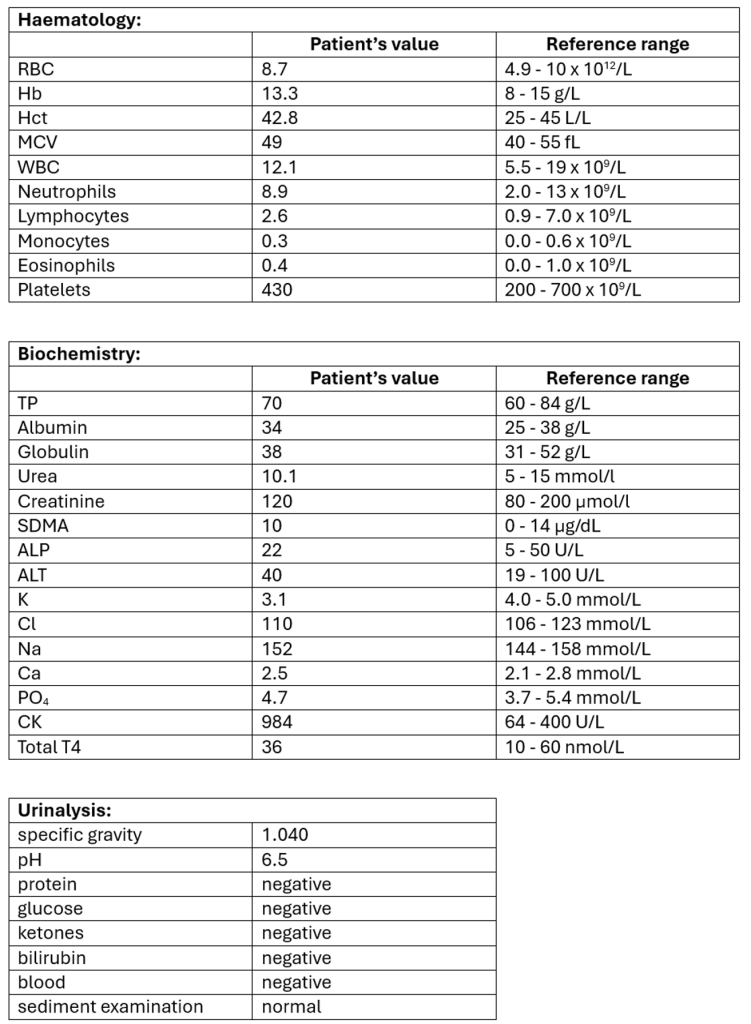
Haematology, biochemistry, and urinalysis results are detailed below:
Feline-Table-751x1024-1

Tip: Make a note of the abnormal results for easy reference later.

See more See less


Finding a diagnosis 

What are the differentials for the test results?


The lab results include hypokalaemia and high creatinine kinase....

Differential diagnoses for hypokalaemia include: 

  • Decreased intake: 
  • Inappetence/anorexia 
  • Low-potassium diet or fluid therapy with inadequate potassium 
  • Increased losses: 
  • Gastrointestinal: 
  • Vomiting/diarrhoea 
  • Urinary: 
  • Renal disease 
  • Diuresis – diuretics, diabetes mellitus, post-obstructive diuresis 
  • Hyperaldosteronism 
  • Hyperadrenocorticism 
  • Intracellular translocation: 
  • Hyperthyroidism 
  • Metabolic alkalosis 
  • Insulin therapy 


Differential diagnoses for increased creatine kinase include: 

  • Muscle damage – trauma (e.g. difficult venipuncture, prolonged recumbency), inflammation/infection, aortic thromboembolism, envenomation 
  • Myopathy – hypokalaemia, taurine deficiency 
  • Anorexia 
  • Artifact (haemolysis) 

The presence of hypokalaemia along with elevated CK suggests a hypokalaemic myopathy. 


See more See less

What is your most likely diagnosis?

Given the concurrent hypertension and hypokalaemia, the most likely differential is hyperaldosteronism. 
See more See less


Well done! You have a likely diagnosis, but the case doesn't stop there. Think about what you know about this condition, and what your next steps will be.

How will you further investigate this case?


  • Plasma aldosterone concentration to assess for elevated aldosterone. 
  • Abdominal ultrasonography to assess for an adrenal mass or hyperplasia, and invasion into surrounding structures (for surgical planning). 
See more See less


Test results

Plasma aldosterone concentration was elevated at 3200 pmol/l (reference <400).

Abdominal ultrasonography identified a well-defined hypoechoic, left adrenal mass measuring 1.8 x 2.3cm. The right adrenal gland was normal.

An aldosterone: renin ratio was not performed in this case but is useful to differentiate primary (high ratio) from secondary hyperaldosteronism (low ratio). The presence of the adrenal mass combined with elevated aldosterone, hypokalaemia and hypertension was sufficient to confirm a diagnosis of primary hyperaldosteronism in this cat. 

See more See less


Treatment

With a definitive diagnosis, it's time to think about treating your patient...

What treatment would you recommend for this cat?


Surgical excision of the left adrenal gland was recommended but declined by the owner due to financial constraints. The following medical management was implemented: 

  • Anti-hypertensive: Amlodipine 0.625mg/cat q24hr PO 
  • Aldosterone antagonist: Spironolactone 2mg/kg q12hr PO 
  • Potassium supplementation: Potassium gluconate 3mEq/cat q12hr PO 


See more See less

How would you monitor this cat's progress?

Ongoing biochemical and blood pressure monitoring is imperative, and 10 days later this cat represented as normokalemic (4.3 mmol/L) and normotensive (145mmHg). The owner reported she was back to normal and jumping without issue. The cat was reassessed in 1 month, then again 2 months later, and remained clinically well. 
See more See less


Discussion

For more information about the diagnosis, click the button below.

Spoiler alert! Only read this section when you've got your diagnosis.

Primary hyperaldosteronism (PHA) is underdiagnosed, despite being the most common adrenocortical disorder in cats. This may be due to the common association of hypertension and/or hypokalaemia with CKD – when in fact, CKD may be a consequence of PHA.  

PHA typically occurs in middle-aged to older cats and is characterised by excessive autonomous aldosterone secretion by an adrenal tumour (adenoma or carcinoma), or less commonly, bilateral adrenal hyperplasia.

Clinical signs reflect excess aldosterone secretion i.e. increased sodium and water retention (hypertension) and increased potassium excretion (weakness). However, the absence of either hypertension or hypokalaemia does not exclude hyperaldosteronism – making diagnosis tricky!

Surgical adrenalectomy is potentially curative for unilateral disease but is associated with a high mortality rate due to haemorrhage. Cats managed medically have reported survival times of months-years.

This case highlights the importance of considering PHA as a differential in hypokalaemic and/or hypertensive patients, as well as the significance of blood pressure screening in older cats. 

See more See less


We hope you enjoyed this feline medicine case. 

Don’t forget to log reading this article this as CPD and reflect on what you've learned! Our article "Reflecting on your veterinary CPD" might be helpful if you're struggling with CPD reflection.

IVE_GPCert(FelP)_OL_CourseThumb (1)
online

Feline Practice

ISVPS General Practitioner Certificate (GPCert)

Postgraduate Certificate (PgC)

date Sep 2026 location Online