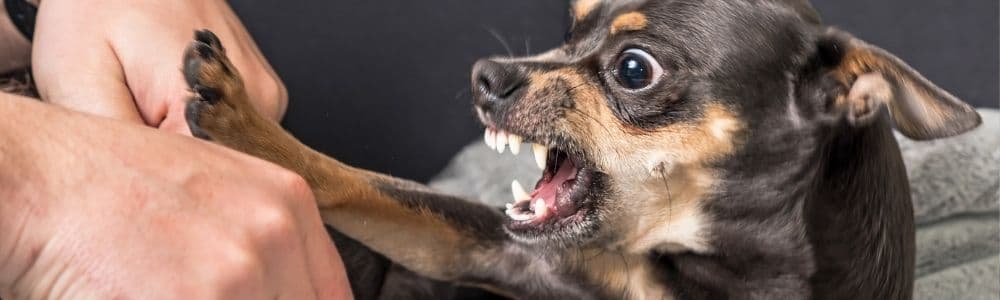
Do you know what to do if a dog becomes aggressive in your consultation room? How can you get yourself, and others, out safely?
I am a Certified Clinical Animal Behaviourist and I’ve been teaching defensive handling to rescues for several years. These ‘safety skills’ can be learned by anybody and can help you prevent and de-escalate canine aggression to turn a dangerous situation into a safer one.
What are Safety Skills?
Also known as defensive handling – safety skills are just like ‘defensive driving’ - being proactive, rather than reactive. In a veterinary context, aggression is frequently due to fear, pain or fear of pain (Riemer et al. 2021). When faced with a perceived threat, many animals will choose to move away from the interaction. When the danger is perceived to be too close, and there is no escape route, animals may use forward-moving body language, including aggression, to create space (Panskepp, 1998). An animal’s stress may therefore pose risk to the veterinary team (Nibblett, Ketzis & Grigg, 2015). Safety skills are the way that we reduce this risk, and keep everyone safe.
An animal’s stress may therefore pose risk to the veterinary team. Safety skills are the way that we reduce this risk, and keep everyone safe.
Step 1: Information gathering
With known fearful or aggressive cases, information gathering ahead of time is the key to success of the session. By exploring the animal’s history, we can make a plan to mitigate the potential risks. Does the dog have a bite history, and if so, what was the level of injury? What techniques have been tried in the past, for example, does the the dog find it less stressful to be examined on the floor, rather than the table? If there is time to plan ahead of the session, it may be beneficial to:
- Chat to the client in advance of session so you know what to expect
- Meet outside the building first and move at the dog’s pace
- Allow for a longer appointment time
- Consider your position in the room
- Be aware of the dog’s safe space
- Consider your own body language
- Take care with movements, food and equipment
- Adapt the session, such as on the floor, in a larger space, or in the car park
- Explore options for muzzling in advance of entering the building
Step 2: In the consult room
If the dog has no issues with resources, is not nil by mouth, and has no dietary issues, you may want to consider using a mix of rewards of varying values as this can increase the response rate (Steinman, 1968). The use of toys may also be beneficial as play can improve social cohesion between humans and dogs, increasing their familiarity and reducing agonistic interactions (Sommerville, O’Connor and Asher, 2017). A study by Salomons et al. 2025 also found evidence that play after training helped dogs who were in the early stages of learning new behaviours improve when they revisited the training the next day.
Having a practice enrichment or ‘behaviour box’ including ready to go resources, such as lick mats, snuffle mats or Kongs may help more anxious patients.
Food enrichment is known to reduce abnormal behaviours (Schipper et al. 2008), so having a practice enrichment or ‘behaviour box’ including ready to go resources, such as lick mats, snuffle mats or Kongs may help more anxious patients. A study by Squair et al. (2023) used Lickimats® as part of low-stress interventions during veterinary visits and they were found to have a greater reduction in stress over time compared to those without interventions.
Reading canine body language
Reading canine body language can help prevent escalations in behaviour. The following traffic light system is a quick introduction to canine body language:
| Red body language | Amber body language | Green body language |
|
Indicates that a dog is feeling very uncomfortable – stop what you’re doing |
Indicates that a dog may be feeling uncomfortable. They are trying to communicate this without needing to use aggressive behaviour – proceed with caution as they may escalate to the red light |
May indicate that a dog is relaxed – green light to carry on, but be mindful that the light may change to amber or red at any point, so continually monitor body language |
|
Biting Snapping Growling Snarling Lunging forwards Freezing |
Tail tucked or high and stiff Ears pinned back Body creeping Stomach exposed Cowering or leaning away Turning or walking away Body weight shifted forwards Tension in body, may be standing tall Lifting lips Whiskers flare forward Hard stare - eyes fixed and forwards Whites of eyes showing - 'whale eye' Deep or booming vocalisations Hackles raised Muzzle appears puffed up Tightly closed mouth Yawning Lip licking Whole body shake off Pawing/ scratching Sniffing Urinating |
Body free from tension Movement loose and wiggly Tail hangs and moves loosely, free from tension Relaxed facial muscles, no wrinkles Ears are in a neutral, or slightly forward position Eyes are round without the whites showing Mouth is relaxed – may be softly closed or open, tongue may loll out Not focused on anything in particular |
Doggie Language by Lili Chin is a truly fantastic resource for anyone to learn about dog body language – I recommend it to every client and professional I work with – full of beautifully illustrated cartoons, it’s super easy to flick through and even great for children!
Alongside body language changes, some other indicators that a dog may be reaching their threshold are:
- Paying more attention to other stimuli e.g. noises
- Not taking food / snatching food
- Invigoration of behaviour i.e. jumping / mouthing
- Not able to respond to known cues, or a ‘time delay’ when responding
Responding to body language clues in the consult room
It is important to constantly assess body language and be aware of the subtle, low-level signals that a dog may be feeling uncomfortable. Each dog will have their own unique communication system, based on what has been effective for them in the past. If we ‘listen to the whispers’ in terms of low-level communication, a dog may not feel the need to escalate their behaviour, or ‘shout’ for space - when choices are removed, options become reduced. When proceeding with caution, with ‘amber’ body language, it is important to consider:
- Is this essential? Can it be done another time?
- Is there a less stressful option? Can we change our body position to give more space? Can we change equipment? Can we change the environment, e.g. the car park? Can we ask the owner to take a picture or video?
- Is there someone I can call? A problem shared is a problem halved! A second person may provide new ideas to approach the situation or help distract the dog
If a dog shows ‘red’ body language – stop what you are doing. Leave the environment, if it is safe to do so, and call for support. If a situation is essential but it has been stressful for the dog, it is important to document this information for the future. Information to record includes the events that led to the incident, the body language and behaviour of the dog, what actions were taken and any resulting injury. This helps from a staff safety perspective but also from the dog's - we may need to put some plans in place for future visits to help mitigate any future risk and to help the dog learn alternative coping strategies.
When working with dogs it is important to be mindful of always adopting safe body positions that mean you can get yourself to safety if a dog’s body language changes:
- Kneel on one knee – means you can stand quickly, if you need to
- Crouch down – an alternative to kneeling – but be mindful of your balance
- Sit down – may provide a safer option than standing / leaning over a dog
- Standing – angle your body slightly away from the dog as this is less confrontational
De-escalating situations
If a dog is displaying body language that makes you feel threatened:
- Raise the alarm - communicate with anyone who is around you clearly and assertively
- Remain calm and still with no sudden movements
- Avert eye contact and angle your body away from the dog
- Can you place a barrier between you and the dog? Think doors, gates, chairs / furniture, bin, blanket, clothing, dog bed, mop or brush
- Use your arms to block your body
- Stay upright – stand with your back to a wall if you are concerned about being knocked over
- If the dog is heavy set, can you gain height?
- Edge sideways towards an exit if possible
- If you fall over, curl into a ball with hands over your head and neck
If you are bitten
1. Raise the alarm
2. Respond – how you respond will depend on the type of bite:
Snapping bites
- Stop what you are doing (if safe to do so)
- Stand still – with the dog in your line of vision
- If safe, slowly move away
- Angle body away, arms close to body
Ragging bites
- Can you drop the item being ragged?
- Can you move to a secure area and drop the item?
- Can you give them something else to trade?
- If clothing is being ragged, can you remove a layer?
- Brace yourself against a wall / furniture
- Attach an additional lead to the dog for security
Grabbing and crushing bites
- Be as still as you can
- Remain calm
- Talk to the dog to keep you breathing normally and lower your heartrate
- Push INTO the bite
3. Report
When reporting, be sure to include the level of bite - the Dunbar Dog Bite Scale is a widely recognised scale.
Conclusion
Every practice will see aggressive dogs from time to time. Many of these dogs are responding to fear, pain, or the fear of pain, and early planning and practice-based interventions can reduce the risk of aggression. Constantly monitoring dog body language and responding appropriately as outlined helps to keep staff, pet owners, and their dogs safe.
References (click to expand)
Nibblett, B.M., Ketzis, J.K. and Grigg, E.K., Comparison of stress exhibited by cats examined in a clinic versus a home setting, Applied Animal Behaviour Science, Volume 173, 2015, Pages 68-75, ISSN 0168-1591, https://doi.org/10.1016/j.applanim.2014.10.005
Panksepp, J. Affective Neuroscience: The Foundations of Human and Animal Emotions; Oxford University Press: Oxford, UK, 1998
Riemer S, Heritier C, Windschnurer I, Pratsch L, Arhant C, Affenzeller N. A Review on Mitigating Fear and Aggression in Dogs and Cats in a Veterinary Setting. Animals. 2021; 11(1):158. https://doi.org/10.3390/ani11010158
Salomons H, Ramsaran LN, Turner J, Hare B. Does Play After Training Improve a Canine Good Citizenship Skill in Pet Dogs? Animals (Basel). 2025 May 10;15(10):1378. doi:10.3390/ani15101378. PMID: 40427256; PMCID: PMC12108483.
Schipper, L.L., Vinke, C.M., Schilder, M.B.H. and Spruijt, B.M. The effect of feeding enrichment toys on the behaviour of kennelled dogs (Canis familiaris), Applied Animal Behaviour Science, Volume 114, Issues 1–2, 2008, Pages 182-195, ISSN 0168-1591, https://doi.org/10.1016/j.applanim.2008.01.001
Sommerville, R., O’Connor, E.A. and Asher, L. Why do dogs play? Function and welfare implications of play in the domestic dog, Applied Animal Behaviour Science, Volume 197, 2017, Pages 1-8, ISSN 0168-1591, https://doi.org/10.1016/j.applanim.2017.09.007.
Steinman, W.M. Response rate and varied reinforcement: Reinforcers of similar strengths. Psychon Sci 10, 35–36 (1968). https://doi.org/10.3758/BF03331393
Squair C, Proudfoot K, Montelpare W, Overall KL. Effects of Changing Veterinary Handling Techniques on Canine Behaviour and Physiology Part 1: Physiological Measurements. Animals. 2023; 13(7):1253. https://doi.org/10.3390/ani13071253
Author
Ashley Szafranek is a Certified Clinical Animal Behaviourist and accredited dog trainer based in Glasgow. Ashley has spent the majority of her career working in the rescue sector. In recent years she taught defensive handling techniques to rescue staff to help keep them safe. She is keen to help spread knowledge of this training to the veterinary sector to help reduce incidents in practice. Ashley runs her business, Reach Your Pawtential, supporting owners with behaviour cases and fellow professionals with clinical cases and mentoring.