
Many common species of companion animal can be active at night. Think of the ubiquitous domestic cat, for example. Readers may be aware that cats have evolved to hunt at night, as well as be active during daylight hours; when these activities are restricted, problem behaviours can occur.
Understanding the sleep–wake cycle of other nocturnal species housed as pets or companion animals, such as hamsters, gerbils, certain reptiles and even some fish, allows for the correct care to be provided.
By the end of this article, readers should be able to:
- Understand the behavioural rhythms of common companion and domestic animals
- Understand why embedding knowledge of activity patterns into housing and husbandry can improve animal health and welfare
- Provide advice to clients on good husbandry practices for common nocturnal companion animals
How do we classify species based on their nocturnal activity?
Species can be classified as diurnal, crepuscular, nocturnal or cathemeral depending on their preference for when to be active during a 24-hour period (Figure 1). Owners should be aware of when their pet is likely to be active, and thus perform a wider diversity of behaviour patterns, to ensure that housing and care facilities meet the species’ behavioural needs.
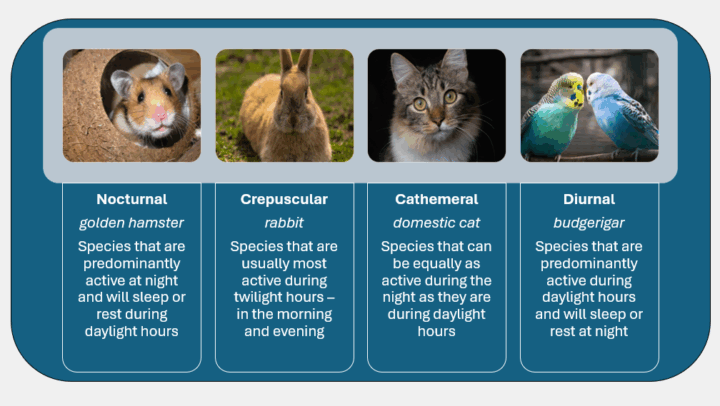
Species with a nocturnal nature have distinct behavioural needs, patterns and health indicators that differ from diurnal animals. Understanding these behaviours is crucial for both pet owners and veterinary professionals when assessing health.
Take lethargy or being withdrawn, for example. This may be harder to identify in a nocturnal species as their activity pattern means they are likely to be resting or asleep when owners are up and about, whereas the behavioural repertoire of a diurnal species is generally more obvious in comparison. Therefore, knowledge of the behaviour of nocturnal species is important because it allows pet owners and veterinary surgeons to assess welfare more accurately. Observations made during the daytime may not give a true representation of the animal’s (and individual’s) typical behaviour.
How does nocturnal activity relate to pet behaviour?
Key welfare indicators that link to behaviour include:
- General (species-typical) activity: a healthy nocturnal animal will move around more at night, with time spent running, foraging and exploring. Any sudden reduction in these activities could indicate illness, stress or an environment that is not stimulating
- Appetite and foraging: many nocturnal species are active at night, so they can forage when predators are less likely to be present. Thus, food selection and consumption mostly occur when the animal feels comfortable enough to be out and about. Owners who do not observe their pet during night-time hours may mistakenly assume that a pet is not eating when, in reality, the animal is consuming a normal intake of food. Any lack of nocturnal feeding is an important red flag for veterinary intervention. For example, no stashing or caching of food by a hamster in their usual shelter may be suggestive of a health or welfare challenge
- “Home range” behaviours: some nocturnal mammals, such as golden/Syrian hamsters (Mesocricetus auratus), are territorial and require solitary housing. Hamsters may spend a long time moving over their enclosure at night, investigating their home range in a similar way to that which is seen in the wild. Any limited social interactions that do take place (eg mating) will occur at night; this should be considered when breeding these species to reduce stress and the potential for injury
- Social behaviours: social nocturnal species, such as sugar gliders (Petaurus breviceps), should be maintained in groups that promote a wide range of social contact. These affiliative behaviours are likely to occur overnight
What advice should vets provide to owners of nocturnal pets?
Overall, veterinary professionals should stress the importance of observation during appropriate hours to gain the best insight into animal health and welfare.
Although it may seem extreme, using a night vision camera (Figure 2) can be an excellent way of assessing normal behaviour patterns. It can also help owners to feel connected to the animal during a time when they want to be awake and active. Use of such technology could be considered a movement towards “best practice” for the management of nocturnal species as it enables owners and veterinary professionals to thoroughly check body condition, fur condition, orientation, stance, locomotion and other indicators of good health.
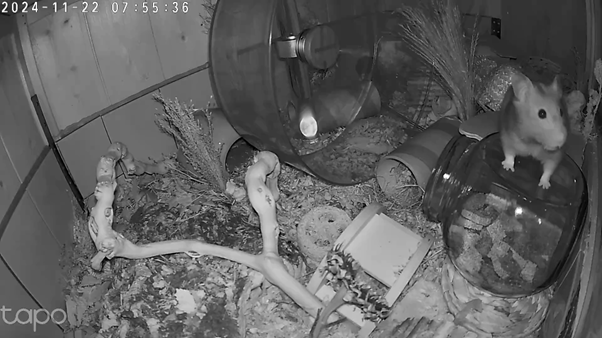
Many common health issues seen in nocturnal pets arise from a lack of understanding of their needs and wants (ie when they want to be stimulated and when they want to be left to rest). Improper handling, unsuitable housing and inadequate enrichment that is not accessible at the right time of the day can result in an unhappy pet and an unhappy owner.
Veterinary surgeons can educate owners on respecting their pets’ sleep schedules, explaining the importance of rest to good physical and mental well-being.
Lighting
Excessive artificial lighting can disrupt sleep–wake cycles, leading to stress-related issues such as aggression, overgrooming or a loss of condition. Owners should ensure that their pets have a dark, quiet area to sleep during the day and that night-time activity can be performed by the animal without disturbing human members of the household.
Think about timers for aquarium lighting – do not suddenly plunge fish into darkness, or conversely, do not cause aquarium lights to come on abruptly when fish have been in the dark. For sensitive nocturnal species, such as bristlenose catfish (Ancistrus sp.) or upside-down catfish (Synodontis nigriventris), any sudden change to lighting will be very distressing.
Enrichment
Mental and physical stimulation can often be overlooked for nocturnal species, but these factors are important. Appropriate exercise wheels or digging opportunities for rodents, climbing structures for nocturnal lizards and foraging opportunities for rabbits to graze into the evening all promote beneficial activity.
Cleaning and maintenance routines
Consider the timing of cleaning and maintenance routines, and when husbandry will be provided. A hamster that appears fearful and prone to biting, for example, may be upset by being disturbed by cleaning during a period they would rather be asleep.
Handling
Handling should be done during the pet’s naturally active hours whenever possible to avoid undue stress.
What is the link between behavioural needs and stress?
Stress is a major factor in both the health of nocturnal pets and the state of their relationship with their caregiver. Stress generally results from an environment that does not cater to their natural instincts, as has been outlined above. Careful consideration on the part of the owner as to how best to cater for the needs of a nocturnal species should be undertaken before such an animal is acquired. Even seemingly “easy-to-keep” species, such as hamsters, are actually quite specialised in their behavioural needs.
Common stressors experienced by nocturnal companion species include:
- Disturbance and disrupted rest due to an inappropriate location for the enclosure
- Inappropriate social housing where a species has no option but to share space with others and have no way of retreating from conspecifics
- A lack of choice over resting, nesting or hiding spaces – what the owner deems as suitable may not be the animal’s first choice
Highlighting the potential impacts of such stressors, as well as explaining the relative ease of rectifying them, should be part of the advice provided to pet owners to ensure they understand the importance of environmental and social considerations for a companion animal’s welfare.
Conclusion
Understanding the behaviour of nocturnal species commonly kept as pets is crucial for upholding their good health. Owners must align their care practices with the natural activity patterns and needs of their pets, and veterinary professionals should offer informed, species-specific advice.
Small rodents, and other nocturnal species such as reptiles and fish, are not disposable pets.
By recognising the importance of their nocturnal behaviours, both caregivers and veterinary professionals can significantly enhance an animal’s overall quality of life, and ultimately the owner will have a more rewarding and fulfilling relationship with their pet.
Key questions for further discussion
- How can enrichment be designed, developed and implemented in a way that enables diverse nocturnal and/or crepuscular activity patterns to be performed?
- How can cameras or remote video monitoring be used more readily in domestic settings to allow owners and caregivers to assess the behaviour patterns and welfare of their pet overnight or in the early morning?
| Useful resources for further reading: - Fischer, K., Gebhardt-Henrich, S. G. and Steiger, A. (2007) Behaviour of golden hamsters (Mesocricetus auratus) kept in four different cage sizes. Animal Welfare, 16, 85-93 - Fox, A. and Neville, V. (2024) Burrowing for answers: investigating Syrian hamster welfare through owner surveys. Veterinary Record, 195, e4534 - Hauzenberger, A. R., Gebhardt-Henrich, S. G. and Steiger, A. (2006) The influence of bedding depth on behaviour in golden hamsters (Mesocricetus auratus). Applied Animal Behaviour Science, 100, 280-294 - Meredith, A. and Johnson-Delaney, C. (2010) BSAVA Manual of Exotic Pets, 5th edition. British Small Animal Veterinary Association, Quedgeley - Yeates, J. (2019) Companion Animal Care and Welfare: The UFAW Companion Animal Handbook. John Wiley and Sons, Chichester |
.png?height=200&name=download%20(2).png)