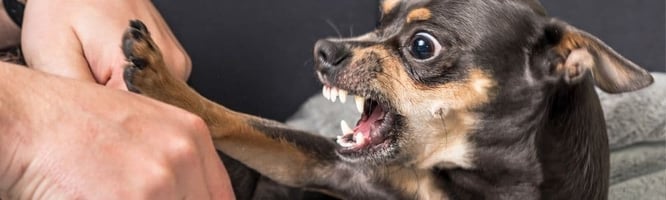
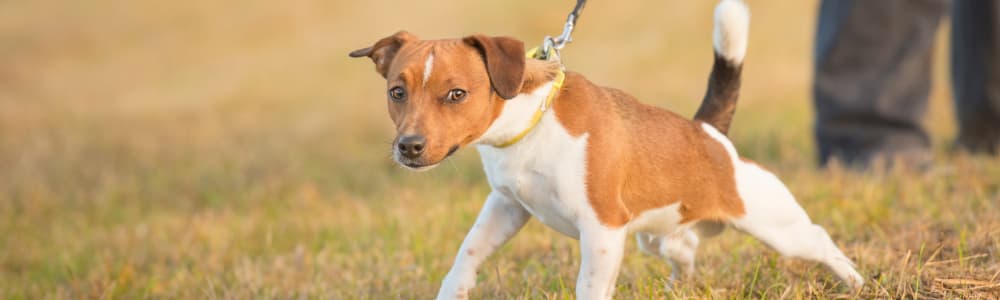

Out comes the harness and off goes the dog. Behind the sofa, under the table, around and around. “We have to corner him to get it on” says his owner. “He loves his walks and runs to the door once it’s on though”.
In my ten years practicing clinical behaviour, I have seen variations of this story play out in people’s homes many times. Some dogs avoid their harness with lowered bodies, tucked tails and attempts to hide, others “fool around”: grabbing toys and getting wriggly and silly in an attempt to escape the inevitable. A small number of dogs will use threats – baring teeth or air snapping, and on rare occasions, some may even have to resort to a nip or bite.
So frequently did I find myself witnessing these “fight, flight, freeze or fool around” responses to harnesses (and so rarely do I see this response when owners opt for a collar and lead), that in 2024 I jumped at the chance to undertake PhD research on the topic. Thus far, what I have learned is fascinating and not what I expected at all.
Are harnesses “better” for dogs than collars?
In recent years, harnesses seem to have become the default “welfare friendly” walking equipment choice, with numerous dog professionals and welfare organisations advocating for harnesses as being universally preferable to the traditional collar and lead.
But why, if harnesses are better for dogs, do some dogs display behaviours that suggest avoidance and even aversion to this piece of equipment? And what do we mean by “better”?
Risks associated with collar wear
When scientists used a simulated neck model to test a range of collar designs under force applied via a leash, all of the collars tested exerted pressure on the neck great enough to potentially cause damage (Carter, McNally & Roshier, 2020). The collars were tested under three magnitudes of force (40N, 70N and a “lead jerk” of around 141N) and a pressure sensor strip used to record both overall pressure and distribution of pressure around the canine neck model.
Results showed variation between collar designs and force levels. The lowest overall pressures were exerted by the padded webbing collar (105kPa), padded sports collar (125kPa) and lurcher collar (83kPa) at 40N of force, with the padded webbing collar, lurcher collar and slip lead also showing lowest overall pressure at 70N of force (182kPa, 160kPa and 160kPa). When a lead jerk was applied, the slip lead exerted the lowest overall pressure (182kPa) and the rolled leather collar exerted the highest overall pressure on the neck model (814kPa). The authors were quick to point out that all of these pressures far exceed the 4.3kPa level thought to cause tissue damage and death in humans.
Where distribution of pressure was concerned, at 40N some devices distributed pressure evenly (padded collars, check chain, leather collar) whilst others increased pressure to both sides of the neck (rolled leather) or to one side of the neck (lurcher collar and slip lead). At higher forces, distribution of pressures for some collars stayed the same, however the padded webbing collar went from even pressure distribution to concentrating pressure in the middle of the neck, and the lurcher collar went from one sided to a more even distribution of pressure.
These findings may be contrary to what pet owners might imagine and show to importance of taking lead walking behaviour into account when choosing an appropriate restraint device, with pressure representing the main risk if selecting a collar and lead as the primary method of restraint/ control.
Why don’t dogs avoid collars?
Dogs certainly do avoid collars (and other types of equipment), although this is much rarer in my experience in clinical behaviour practice. The same dogs that flee when a harness is presented, are more often than not perfectly happy to have a collar and lead put on.
So, if collars cause harm, and therefore presumably discomfort, why don’t dogs avoid them in the same way they avoid harnesses?
The key to this probably lies in the way dogs learn. Dogs are wired for powerful associative learning. Their brains very readily link stimuli with significant events, creating strong conditioned responses. In some cases, a single event can produce a lifelong association between two previously unlinked things.
So far, evidence shows that the risk with collars comes when pressure or force from the lead. It is unlikely therefore that having a collar put on would be aversive for the vast majority of dogs. It is much more likely that the collar is strongly associated with the excitement of going for a walk as this is the most immediate significant event that would occur for the dog once the collar is on!
What harm could a harness do?
When a dog is displaying avoidant behaviour, such as fooling around or hiding, or when they use threats or distancing behaviours, this suggests the dog is finding something about the stimulus aversive. In the case of harness avoidance, very little research has been undertaken that directly investigates these behaviours, however potential reasons could include an aversion to the harness going over the dog’s head and / or the sounds of fastenings (clips and Velcro) being aversive, or that the wear of the harness itself is uncomfortable for the dog.
Without a gentle introduction, equipment that fits over or around the head can be scary, and can combine with medical issues such as sore ears, teeth, head or neck to cause a strong negative association. Badly fitted or poorly made harnesses may also rub, irritate or even snag (especially with “hairy” breeds like poodles and poodle crosses!), further causing the dog to find wearing a harness uncomfortable. If aversive sensations caused by the harness are present consistently enough during fitting and wear, the dog will still make a strong association between the harness and discomfort and want to avoid that piece of equipment.
Chest strap or Y-shaped? Designs that restrict movement
Research indicates that even properly fitted harnesses may restrict movement. Multiple studies report significant alterations in gait metrics, including stride length, weight distribution, and shoulder and elbow angles, even when walking on a loose lead (Dowdeswell & Churchill 2024; Knights & Williams 2021; Lafuente et al. 2019; Pálya et al. 2022; Williams et al. 2023). Prolonged restriction of joint movement may contribute to abnormal joint loading or muscular strain, which may, in turn, influence dogs’ willingness to wear harnesses during walks.
The potential for harnesses to restrict movement has not escaped the dog world’s attention. Many dog owners and professionals regard certain harness designs as problematic, with those featuring a horizontal chest strap being widely regarded as more restrictive to movement than those with a Y-shaped chest piece and strap between the front legs. This does not hold true in studies comparing these designs however, with studies showing that in some cases “non-restrictive” Y-shaped harnesses limit movement more than “restrictive”/ chest strap designs (Lafuente et al. 2019, Weissenbacher et al. 2022).
A recent study by Williams et al (2023) found that restriction of thoracic limbs likely depends on the specific anatomy of the dog, with relatively longer limbed dogs being less restricted by a chest strap due to its position in relation to shoulder anatomy. Further research in this area is lacking, and the addition of pressure/ force and effect of material and padding are yet to be investigated.
Helping owners get it right
Owners want the best for their dogs but are also likely to encounter misinformation and conflicting advice. We can help owners by:
- Encouraging them to pay attention to behavioural signs: avoidant behaviour signals a potential issue and could be the early warning signs of physical discomfort or a broader behavioural issue.
- Advising on equipment type: If the dog isn’t a lead puller, then a collar and lead is the least restrictive option. Advice on equipment type should take into consideration the need for control along with comfort for the dog and any medical or behavioural conditions which could be exacerbated by pressure or joint restriction.
- Checking the design and fit of the equipment is appropriate to their dog: most harness manufacturers size their products based on girth measurement only, however checking the harness does not restrict thoracic limb movement or rub/ pinch the skin is important and should be done regularly to avoid discomfort. Dogs that don’t like equipment fitted over the head may be better in a harness that fastens around the neck/ body instead, and those scared of Velcro sounds maybe prefer clips instead.
- Encouraging positive conditioning to equipment: owners should introduce new equipment gradually and with lots of rewards to build a positive association with fitting and wear. Dogs that already have a negative aversion will take longer to feel comfortable, but starting with an entirely new piece of equipment can provide a clean slate to work from and yield good results if the owner takes their time.
- Reminding owners that dogs need LOTS of training: No piece of equipment will replace time and energy spent teaching a dog to walk on a loose lead and follow basic cues. Working with an accredited trainer gets the best results for most owners as they benefit from real time coaching and feedback with an approach that is bespoke to them and their dog.
Conclusion
The U.K. may be home to over 13 million dogs (McMillan et al. 2025) and so the impact of walking equipment on their health and behaviour is important to pay attention to. Behavioural indicators of discomfort or aversion provide one way we can access the dog’s point of view in relation to their experiences.
There is likely no universally “better” piece of waking equipment for dogs and no replacement for training and shaping behaviour to ensure adequate control. For dogs with excellent loose lead walking, a flat collar and lead is a low risk and unrestrictive option. For dogs that pull or lunge, a well fitted harness which takes into consideration their normal gait patterns will provide a compromise between control and comfort.
References (click to expand)
References
Carter, A., McNally, D. and Roshier, A. (2020). Canine collars: an investigation of collar type and the forces applied to a simulated neck model. Veterinary Record, 187(7), p.vetrec-2019-105681. doi:https://doi.org/10.1136/vr.105681.
Dowdeswell, L. and Churchill, L. (2024). The Influence of Harness Design on Forelimb Biomechanics in Pet Dogs. Reinvention an International Journal of Undergraduate Research, 17(S1). doi:https://doi.org/10.31273/reinvention.v17is1.1372.
Knights, H. and Williams, J. (2021). The influence of three working harnesses on thoracic limb kinematics and stride length at walk in assistance dogs. Journal of Veterinary Behavior, [online] 45, pp.16–24. doi:https://doi.org/10.1016/j.jveb.2021.05.011.
Lafuente, M.P., Provis, L. and Schmalz, E.A. (2018). Effects of restrictive and non-restrictive harnesses on shoulder extension in dogs at walk and trot. Veterinary Record, 184(2), pp.64–64. doi:https://doi.org/10.1136/vr.104946.
McMillan, K.M., Harrison, X.A., Wong, D.C., Upjohn, M.M., Christley, R.M. and Casey, R.A. (2024). Estimation of the size, density, and demographic distribution of the UK pet dog population in 2019. Scientific Reports, [online] 14(1). doi:https://doi.org/10.1038/s41598-024-82358-y.
Pálya, Z., Rácz, K., Nagymáté, G. and Kiss, R.M. (2022). Development of a detailed canine gait analysis method for evaluating harnesses: A pilot study. PLOS ONE, 17(3), p.e0264299. doi:https://doi.org/10.1371/journal.pone.0264299.
Weissenbacher, A., Tichy, A., Weissenbacher, K. and Bockstahler, B. (2022). Influence of Two Types of Guide Harnesses on Ground Reaction Forces and Step Length of Guide Dogs for the Blind. Animals: an open access journal from MDPI, [online] 12(18), p.2453. doi:https://doi.org/10.3390/ani12182453.
Williams, E., Hunton, V., Boyd, J. and Carter, A. (2023). Effect of Harness Design on the Biomechanics of Domestic Dogs ( Canis Lupus familiaris ). Journal of Applied Animal Welfare Science, 28(2), pp.1–17. doi:https://doi.org/10.1080/10888705.2023.2259796.
Author
River McDonald is a Certificated Clinical Animal Behavourist and full member of the Association of Pet Behaviour Counsellors and has been working with dogs and their owners for 25 years. In addition to heading the Clinical Behaviour team at Edinburgh Dog Behaviour, River is also a second year PhD researcher at Scotland’s Rural College (SRUC) exploring the application of machine learning to gait and movement analysis in dogs.