
Stellen Sie Ihre Kenntnisse in der Katzenmedizin auf die Probe und testen Sie Ihre praktischen Fähigkeiten mit dieser kostenlosen Fallstudie zur Katzenmedizin, die Ihnen von Dr. Jacqui Victor BVSc MANZCVS (Medicine of Cats) zur Verfügung gestellt wird.
History
A female (neutered) domestic shorthair cat, Lyra, aged 11, presents to your practice for “weakness”. On discussion with the owner, she has had intermittent weakness and has been unable to jump onto high surfaces for the last week. The owner mentions she’s had a few accidents in the house, and has noticed she has been drinking a bit more recently. She is kept indoors at all times, and is up-to-date with vaccinations.Clinical Exam
Lyra weighs 4.9 kg and has a body condition score of 5/9. Her mucous membranes are pink, with a capillary refill time of 1.5 seconds. Her heart rate is 164 bpm, and her respiratory rate is 32 breaths per minute. Her temperature is recorded at 101.1°F. Orthopedic evaluation shows no abnormalities. Systolic blood pressure readings (taken via Doppler) consistently measure 185 mmHg. Lyra is quiet yet alert and responsive throughout the exam.Glauben Sie, dass Sie Lyra diagnostizieren können? Begleiten Sie uns, wenn wir ihren Fall durchgehen:
[mo-optin-form id="YMJOwZvjtV"]Problem List
From the history and clinical exam, what is your problem list for Lyra? List the problems you’ve identified:- Intermittent generalised weakness
- Inability to jump
- Polyuria with polydipsia
- Hypertension
- Haematological – anaemia, polycythaemia
- Metabolic/endocrine – hypoglycaemia, hypokalaemia, hypo/hypercalcaemia, hypo/ hypernatremia, diabetic neuropathy, hyperthyroidism, thiamine deficiency
- Neuromuscular disease – myasthenia gravis, polymyositis, hypokalaemic myopathy, tick paralysis, snake envenomation, organophosphate toxicity, botulism, intracranial disease
- Cardiac – arrhythmia, cardiomyopathy, hypo/hypertension
- Orthopaedic – polyarthritis, osteoarthritis, pain
- Endocrine – hyperthyroidism, diabetes mellitus, hypo/hyperadrenocorticism, central diabetes insipidus, hyperaldosteronism, phaeochromocytoma
- Renal – acute kidney injury, chronic kidney disease (CKD), pyelonephritis, nephrogenic diabetes insipidus
- Electrolyte disturbances – hypercalcaemia, hypokalaemia, hyponatraemia
- Compensatory polydipsia – e.g. gastrointestinal water loss (vomiting/diarrhoea)
- Hepatic disease
- Stress (‘white coat effect’)
- Hypertension secondary to:
- CKD
- Hyperthyroidism
- Hyperaldosteronism
- Phaeochromocytoma
- Chronic anaemia
- Idiopathic
- Cardiomyopathy
Diagnostic Tests
What diagnostic tests would you perform in this case? List the diagnostic tests you’d like to perform, and why... Our certificate-holder would start with:- A neurological examination (to see if the weakness is neurological in origin)
- Fundic examination (hypertensive retinopathy would suggest target organ damage and narrow our differentials list)
- Haematology, serum biochemistry (including total thyroxine) and urinalysis (which would allow us to check for causes of weakness, PU/PD and hypertension, such as ruling in/out anaemia, CKD, or diabetes).
Test results
We undertook the tests described above, and these are the results... Neurological exam: There was no evidence of neurological deficits on neurological examination. Fundic exam: No evidence of retinal haemorrhage consistent with hypertensive retinopathy and target organ damage. Blood test results: [caption id="attachment_5052514" align="alignleft" width="516"]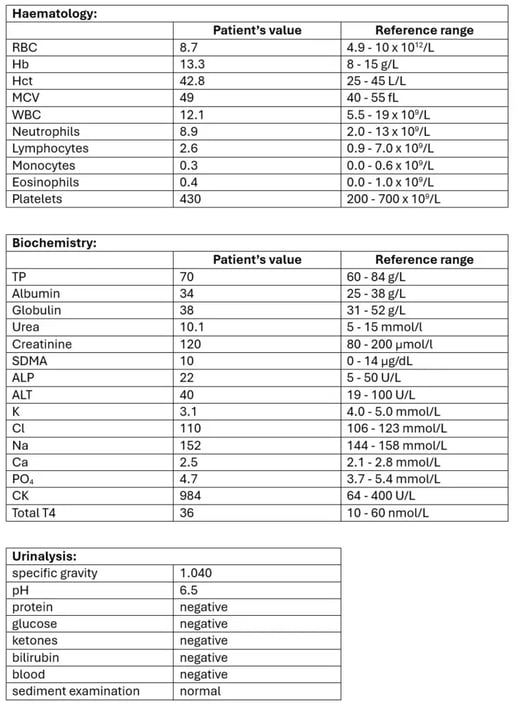 These blood results from the free feline medicine case study might hold the answer to the case.[/caption]
Differential diagnosis
What are the differentials for the abnormal laboratory findings? Differential diagnoses for hypokalaemia include:- Decreased potassium intake:
- Anorexia
- Low-potassium diet or fluid therapy with inadequate potassium
- Increased losses:
- Gastrointestinal:
- Vomiting/diarrhoea
- Urinary:
- Renal disease
- Diuresis – diuretics, diabetes mellitus, post-obstructive diuresis
- Hyperaldosteronism
- Hyperadrenocorticism
- Gastrointestinal:
- Intracellular translocation:
- Hyperthyroidism
- Metabolic alkalosis
- Insulin therapy
- Muscle damage – trauma (e.g. difficult venipuncture, prolonged recumbency), inflammation/infection, aortic thromboembolism, envenomation
- Myopathy – hypokalaemia, taurine deficiency
- Anorexia
- Artifact (haemolysis)
Further investigations
How would you further investigate this case? Are there further tests you can do to confirm your suspicions? Our feline medicine certificate holder would do the following:- Plasma aldosterone concentration (which would allow us to confirm elevated aldosterone)
- Abdominal ultrasonography (with an experienced vet, which should allow us to assess for adrenal hyperplasia or an adrenal tumour. Evidence of invasion of any tumour into surrounding structures will also be important for planning surgery).
Results:
Plasma aldosterone concentration was higher than normal at 3200 pmol/l (reference <400). Abdominal ultrasonography identified a well-defined, hypoechoic, left adrenal mass measuring 1.8 x 2.3cm. The right adrenal gland was normal. Note: In this case, an aldosterone-to-renin ratio was not performed, though it can be a valuable tool for distinguishing primary hyperaldosteronism (characterized by a high ratio) from secondary hyperaldosteronism (characterized by a low ratio). However, the combination of an adrenal mass, elevated aldosterone levels, hypokalemia, and hypertension was sufficient to confirm a diagnosis of primary hyperaldosteronism in this cat.Treatment
What treatment would you recommend for this cat? If you don’t know, why not grab out a textbook now – then read on to see if you’d do the same as our certificate holder! We did recommend surgical removal of the left adrenal gland, but this was declined by the owner due to financial constraints. Thus, we recommended medical management, consisting of:- Anti-hypertensive: Amlodipine 0.625mg/cat q24hr PO
- Aldosterone antagonist: Spironolactone 2mg/kg q12hr PO
- Potassium supplementation: Potassium gluconate 3mEq/cat q12hr PO
Monitoring
How would you monitor this cat’s progress? What tests should you do, and how frequently do you want to see them back? Regular monitoring of blood pressure and biochemical parameters is crucial for cats receiving medical management for feline hyperaldosteronism. Ten days later, the cat returned for evaluation and was found to be normokalemic (4.3 mmol/L) and normotensive (145 mmHg). The owner reported that the cat had returned to normal behavior, including jumping without difficulty. Follow-up assessments were conducted one month and two months later, with the cat remaining clinically healthy throughout this period.Discussion
Primary hyperaldosteronism (PHA) is often overlooked in feline patients, despite being the most common adrenocortical disorder in cats. This may stem from the frequent misattribution of hypertension and/or hypokalemia to chronic kidney disease (CKD). In reality, CKD could be a consequence of PHA rather than the underlying cause. PHA typically affects middle-aged to older cats and is characterized by excessive autonomous aldosterone secretion, usually due to an adrenal tumor (adenoma or carcinoma) or, less commonly, bilateral adrenal hyperplasia. The clinical signs of PHA stem from elevated aldosterone levels, including increased sodium and water retention (leading to hypertension) and excessive potassium excretion (causing weakness). However, not all cases present with both hypertension and hypokalemia, making diagnosis challenging. Surgical adrenalectomy can be curative in cases of unilateral disease, but the procedure carries a high risk of mortality due to complications like hemorrhage. For cats managed with medical therapy, survival times can range from several months to years.Why PHA Should Be on Your Radar
This case underscores the importance of considering PHA in cats presenting with hypokalemia and/or hypertension. It also highlights the critical role of regular blood pressure monitoring, particularly in older feline patients. Early recognition and appropriate management of PHA can significantly improve outcomes. Hat Ihnen diese Fallstudie gefallen? Sie möchten ein Zertifikat in Katzenmedizin erwerben und Ihre Diagnose- und Behandlungskenntnisse verbessern? Dann entdecken Sie doch unser Zertifikatsprogramm für Katzenmedizin als E-Learning-Variante oder Präsenzveranstaltung.Autor*in

