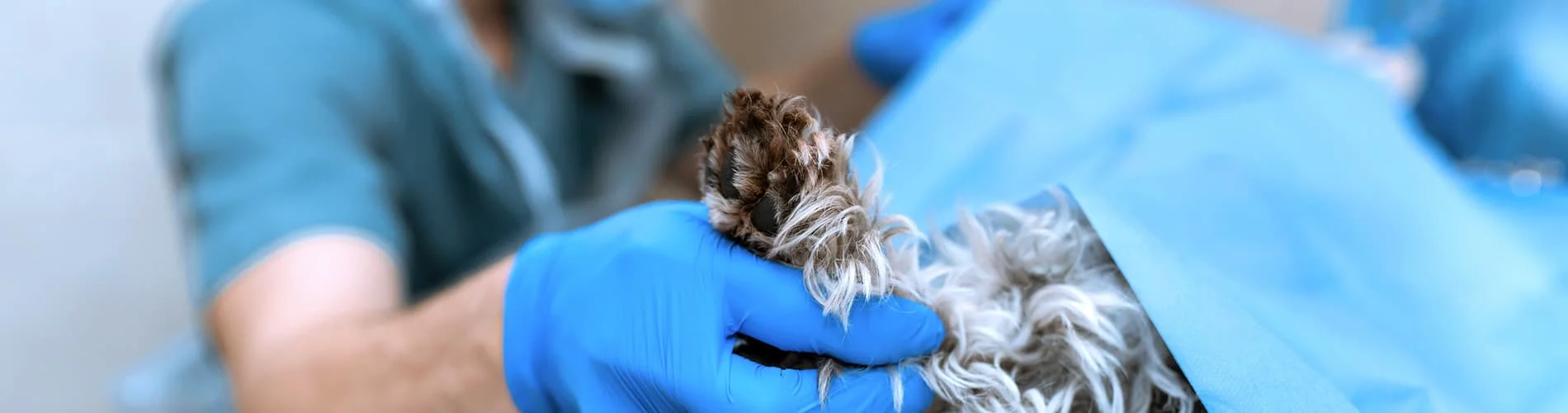
Physical rehabilitation is invaluable to veterinary practice, improving surgical outcomes and patient quality of life.
This unique practical programme is delivered by veterinary surgeons and veterinary nurses who have further qualifications within the subject field. This programme will provide comprehensive knowledge in topics such as general skeletal, myology, sindesmology, arthrology, and topographic review and hands-on training in physiotherapy and rehabilitation techniques which can be applied directly back to practice.
What you'll learn:
-
Physiology of pain: A general skeletal, myology, sindesmology, arthrology, and topographic review.
-
Applied physiology: Physiology of healing.
-
Physical rehabilitation techniques: Key areas of assessment and rehabilitation techniques.
-
Patient care: Frequent medical conditions, post-surgical approach. Management of osteoarthritis, neurological and oncological patients
Why choose this programme?
-
The delivery of this programme allows the essential theory of this subject to be presented in an interactive and engaging way by a known expert in the field.
-
Practical teaching provides the skills and knowledge to ensure you gain tangible experience which can be applied directly back in practice.
-
Increase your confidence and job satisfaction with the ability to tackle complex cases and provide advanced care, in turn bringing a sense of accomplishment to your role.
Hear what our delegates have to say
Don’t just take our word for it - our delegate feedback speaks for itself.
Garrick Ponte
BVSc GPCert(SAM) MRCVS
The teaching at Improve is excellent and I have been able to take what I have learnt back to use in practice. It’s not just the lectures themselves but the practical work we did straight afterwards which drives home everything, which is why Impro … Read more
Colin Dickson
BVMS CertAVP MRCVS
Having previously completed a postgraduate surgery certificate with another provider, I was confident in my knowledge and understanding of the theory but felt underprepared from a practical perspective. I was initially hesitant to register for another … Read more
Key features of this programme
A dedicated Programme Coordinator who will support you every step of the way
The NCert and VPPCert is awarded by our global qualifications provider ISVPS
Pre-module and post-module assessments encourage you to reflect on your learning and evaluate your progress
A discussion forum for conversation, debate and sharing cases with your peers
Online study skill lessons
12-month subscription to the RCVS Knowledge Library
A dedicated Programme Coordinator who will support you every step of the way
The NCert and VPPCert is awarded by our global qualifications provider ISVPS
Pre-module and post-module assessments encourage you to reflect on your learning and evaluate your progress
A discussion forum for conversation, debate and sharing cases with your peers
Online study skill lessons
12-month subscription to the RCVS Knowledge Library
Programme details
Module Summary
01 - Introduction to physiotherapy. functional anatomy
This first module will give you an insight into physiotherapy and will review basic anatomy via a wet lab.
Introduction to Physiotherapy. Functional anatomy
• Explain the principles and benefits of physiotherapy and rehabilitation, and the role of the veterinary nurse/technician/paraprofessional within the multidisciplinary team.
• Identify relevant bony landmarks and musculoskeletal anatomy, and assess normal muscles and joints by palpation.
• Assess conformation, posture and gait, and recognise lameness and subtle gait abnormalities.
02 - Applied physiology: physiology of healing.
To restore core stability and joint stability, one needs to apply the knowledge of the physiological properties of our patients. This module aims to study the biological and biomechanical systems, in order to ensure the correct steps can be made into physiotherapy and rehabilitation practices.
Musculoskeletal Assessment Part 2- Evaluation of muscles and joints
• Explain healing and inflammation in muscle, bone, tendon and ligament, including tissue adaptation to immobilisation, remobilisation and fitness.
• Recognise trigger points and tender bands and assess muscle flexibility by palpation.
• Assess joint range of motion and end feel, recognising subnormal and pathological findings.
03 - Physiology and classification of pain, musculoskeletal assessment part 3: myofascial evaluation
This module will cover the pathophysiology and classification of pain so that understanding can be applied during the rehabilitation process.
Key learning objectives:
• Explain pain and nociception, including transduction, transmission, modulation, projection and perception.
• Classify pain by source, location and duration, and explain gate control in pain modulation.
• Assess fascia and recognise adaptations associated with pain and dysfunctional biomechanics.
04 - Neurological and muscle-skeletal assessment: special orthopaedic and neurological tests
This module will continue to explore the neuro-musculoskeletal (NMSK) examination techniques to differentiate between normal and abnormal findings. Thus enabling the accurate recording and monitoring of improvements/signs of deterioration within the rehabilitation process.
Key learning objectives:
• Perform and interpret relevant neurological and orthopaedic tests, including myotatic, cutaneous trunci, anocutaneous, proprioception, deep pain, cranial drawer, patellar stability, Ortolani and bicipital tests.
• Obtain and record goniometry and Gulick measurements and use them to monitor progress or deterioration during rehabilitation.
05 - Physical rehabilitation I: massage therapy, joint mobilisation and stretching.
Physiotherapy involves a number of different treatments and preventative approaches, depending on the specific requirements of the veterinary patient. This module will provide an introduction to the most common physiotherapy techniques used in practice.
Key learning objectives:
• Set realistic rehabilitation objectives using SMART goals and apply safe therapeutic handling, adapting sessions for pain, stress and welfare.
• Explain the principles, indications, contraindications and precautions of cryotherapy and thermotherapy.
• Explain the benefits of PROM, perform a full PROM assessment and devise an appropriate PROM programme.
• Explain stretching principles and safely apply appropriate stretches to major muscle groups.
06 - Physical rehabilitation techniques II: physical rehabilitation techniques part 2: active therapeutic exercises
As far back as 2400 BC when it was first discovered by the ancient greeks water has been used for healing thus the term 'Hydrotherapy' or 'Water healing'. This module looks at Hydrotherapy as a form of non-weight bearing exercise within the rehabilitation process.
Key learning objectives:
• Classify active and passive exercise and explain the myofascial, neurological, cardiovascular and articular benefits of active exercise.
• Prescribe active exercises for balance, proprioception, muscle tone and strength, including contraindications and safety considerations.
• Explain how water affects biomechanics and compare swimming with underwater treadmill hydrotherapy.
07 - Physical rehabilitation techniques III: physical rehabilitation techniques part 3: electrophysical agents
This module will continue to look at therapeutic techniques which can be used in veterinary patients.
Key learning objectives :
• Explain the principles, indications, precautions, contraindications and safety considerations of LLLT, TENS, NMES, ESWT and PEMF.
• Develop appropriate dosing protocols for LLLT, electrical stimulation, ESWT and PEMF, and compare Class IIIb and Class IV laser systems.
• Differentiate TENS and NMES according to therapeutic goal.
08 - Physiotherapy approach to frequent medical conditions. soft tissue, post-surgical, osteoarthritic, neurological and oncological patients
The module will look at a variety of veterinary conditions whereby the patient's recovery and quality of life will benefit from a physiotherapy and rehabilitation approach. You will be able to review all of the other modules in order to formulate a rehabilitation plan for specific patient requirements.
Key learning objectives:
• Use clinical reasoning and SMART goals to create safe rehabilitation plans for post-operative, non-surgical, neurological, oncology and long-stay patients.
• Incorporate objective measurements, manual and electrotherapies and exercise prescription into individual rehabilitation plans.
• Apply reflective practice and an appropriate method for self-reflection.
Qualifications
Nurse/Veterinary Paraprofessional Certificate (NCert/VPPCert)

This course is accredited by ISVPS and allows you to achieve a Nurse/Veterinary Paraprofessional Certificate
To attain the ISVPS NCert qualification, you must be able to prove your eligibility by either uploading your veterinary nursing qualification certificate or RCVS/VCI number to Improve Veterinary Education once you have booked onto your programme of study.
You can attend the modules if you are a student, or not in practice and enrolled with the RCVS; however, you will not be able to attain the ISVPS NCert qualification.
To attain the VPPCert, candidates must pass the eligibility criteria as set by ISVPS. Please contact us for further information.


Pricing
£3,499.00
£3,799.00Payment & VAT Information
1. Many of our courses come with deferred payment and instalment options. Click “Book Now” to see what’s available for this course.
2. All prices will be displayed exclusive of local sales tax.
3. For corporate-paid registrations, the associated corporate discount will apply to the regular course price and cannot be combined with Early Price or other promotions.
Payment Terms & Conditions
Registration Information
100% Satisfaction
We're completely confident in the quality of our training and CPD. So much so that if you're not 100% satisfied with your certificate course, we'll give you a 100% refund. Just get in touch with us within 30 days of your start date and we'll sort the rest. T's and C's apply.
Find out more
FAQs
Veterinary Nurse Certificates
What’s not included in the programme fee? Do I need to budget for any other costs?
What does the programme fee for the vet nurse certificate include?
How long does it take to study a veterinary nurse certificate programme?
How will studying a veterinary nurse certificate programme benefit me and my practice?
What are the assessments for the NCert/VPPCert?
Does the Nurse Certificate/Veterinary Paraprofessional Certificate award postnominals?
What is a Veterinary Paraprofessional Certificate (VPPCert)?
What is a Nurse Certificate (NCert)?
How long do I have to complete a veterinary nurse certificate?
Who is eligible for the veterinary nurse certificate programmes?
What qualifications are needed for the nurse certificate programme if coming from other countries?
Practical Sessions
Where are practical CPD courses or face-to-face modules held?
What will the timings be for face-to-face certificate modules and practical CPD sessions? How will my day be structured?
Where do the cadavers come from for the practical CPD and surgical modules/courses?
What should I wear to a practical CPD course/module?
I will be travelling from overseas, do I need a Visa?
Will the dogs used for practical CPD courses be sedated?
Will the dogs used for scanning have any abnormalities?
Are the dogs used for ultrasound CPD clipped?
Are cats used for any of the ultrasound courses?
Payments & Finance
What payment methods do you accept?
Do you offer any flexible payment plans?
What payment methods can I use for setting up a direct debit?
Do you issue separate invoices for each instalment?
Why was my Direct Debit payment not charged on the day that is established in my payment plan?
Why couldn’t I make payment during check-out?
Where can I find the bank details for the bank/wire transfer?
What happens if my circumstances change and I need to cancel my order?
When is payment for my veterinary CPD course due?
How much do the veterinary CPD courses and certificate programmes cost?
My CPD course includes assessments with ISVPS, how do I make payment for these?
Can I pay by Direct Debit?
Our Clinical Excellence Centre
Discover the new Improve Veterinary Education Clinical Excellence Centre featuring two surgical wet-lab training theatres and a radiology suite.
Find out more